How Often Should You Pump a Septic Tank?
Most homeowners with a septic system know they need to Pump a Septic Tank eventually — but very few know exactly when, how often, or what happens if they wait too long. The short answer: most households need to pump their septic tank every 3 to 5 years. But the real answer depends on your household size, tank capacity, water usage, and system type.
This guide gives you the complete pumping schedule, explains why timing matters, and shows you exactly how to decide when your specific system is due.
How a Septic Tank Works: What’s Happening Inside
Before you can understand pumping schedules, it helps to know what is actually happening inside the tank.
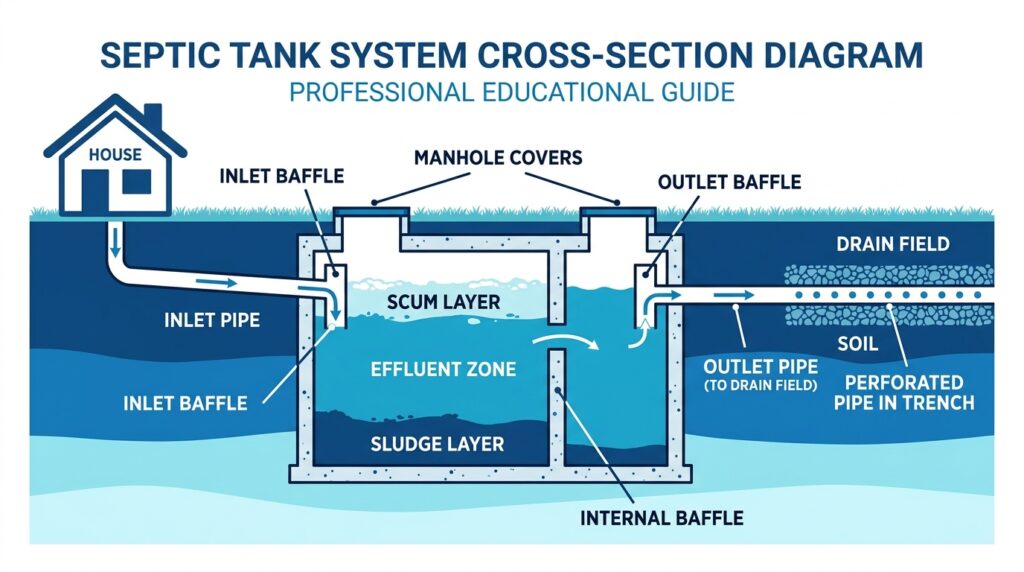
Every septic tank has three distinct layers:
- Scum layer (top): Fats, oils, and greasy materials float to the surface and form a crust.
- Effluent zone (middle): Relatively clear liquid wastewater sits in the center of the tank. This is the layer that continuously flows out to the drain field.
- Sludge layer (bottom): Heavy solid waste sinks and accumulates at the bottom of the tank.

Naturally occurring bacteria inside the tank break down some of this organic material over time, but they cannot eliminate everything. The sludge layer and scum layer grow slowly but steadily. When they together take up more than one-third of the tank’s total volume, the tank can no longer separate waste efficiently, and solids begin flowing into the drain field — which can cause permanent damage costing $5,000 to $20,000 to repair.
Get Free Septic Tank Diagnose Using Our Free Septic Tank Diagnose Tool
Pumping removes the accumulated sludge and scum before they reach that critical threshold.
The Standard Septic Tank Pumping Schedule
The EPA recommends pumping your septic tank every 3 to 5 years as a baseline. However, this is a guideline, not a rule. Your actual schedule depends on four primary factors:
1. Household Size
More people means more waste going into the system every day. A larger household fills the tank faster.
2. Tank Capacity
Smaller tanks fill up faster. A 1,000-gallon tank serving four people needs pumping more frequently than a 1,500-gallon tank serving the same household.
3. Daily Water Usage
High water usage — long showers, frequent laundry loads, running the garbage disposal — sends more liquid into the tank and stirs up solids.
4. System Age and Condition
Older systems or those with damaged baffles may need more frequent attention to prevent failure.
Septic Tank Pumping Schedule by Household Size
Use this table as your starting reference. Actual intervals may vary based on tank size and usage habits.
| Household Size | 1,000-Gallon Tank | 1,500-Gallon Tank | 2,000-Gallon Tank |
|---|---|---|---|
| 1–2 people | Every 5–7 years | Every 7–10 years | Every 10–12 years |
| 3–4 people | Every 3–4 years | Every 4–6 years | Every 6–8 years |
| 5–6 people | Every 2–3 years | Every 3–4 years | Every 4–5 years |
| 7+ people | Every 1–2 years | Every 2–3 years | Every 3–4 years |
Pro tip: If you don’t know your tank’s capacity, check your home inspection report or call your county health department. Most records are available online.
How to Know When It’s Time to Pump
Beyond following a fixed schedule, your septic system will often give you clear signals that it is approaching or exceeding capacity. Do not ignore these signs.
Early warning signs — act soon:
- Slow drains throughout the house (not just one fixture)
- Gurgling sounds in pipes or toilets after flushing
- Unpleasant odors near drains or in the yard above the drain field
- Small puddles or soggy patches of grass over the drain field area
Urgent signs — call immediately:
- Sewage backing up into toilets or tubs
- Standing water or strong sewage smell over the drain field
- Bright green, unusually lush grass directly over the drain field (a sign of effluent surfacing)
If you notice any of the urgent signs, the tank may already be overfull and solids may be reaching the drain field. At that point, simple pumping may not be enough — you may need a full inspection to assess drain field damage.
What Happens If You Don’t Pump on Schedule?
Skipping or delaying pumping is the most common cause of premature septic system failure. Here’s the progression:
- Sludge and scum layers grow past the safe threshold (one-third of tank volume)
- Solids escape the tank and flow into the drain field pipes
- Drain field pipes clog as solid waste blocks the perforations
- Biomat forms — a biological crust in the soil that prevents liquid absorption
- Drain field fails — effluent can no longer be absorbed and surfaces in the yard
- Full replacement required — costs $5,000 to $20,000+ for drain field replacement
Compare this to the cost of a routine pump-out: $250 to $560 on average, depending on your location and tank size. Pumping every 3 to 5 years is one of the most cost-effective home maintenance decisions you can make.
How Much Does Septic Tank Pumping Cost?
Pumping costs vary by region, tank size, and access difficulty. Here are the current national averages:
| Service | Average Cost | Range |
|---|---|---|
| Standard pump-out (1,000-gal tank) | $350 | $250–$500 |
| Standard pump-out (1,500-gal tank) | $426 | $300–$560 |
| Emergency after-hours pumping | $400–$600 | $350–$850 |
| Inspection + pumping combined | $500–$700 | $400–$900 |
| Pump-out + filter cleaning | $400–$550 | $300–$650 |
Factors that increase cost:
- Remote or hard-to-access location
- Tank lids buried deep underground
- Tank has not been pumped in many years (extremely full)
- Filter cleaning or baffle repair needed at same appointment
Save money tip: Get quotes from 3 local septic companies. Many offer discounted rates if you schedule during non-peak seasons (late fall or winter). Use the “Find a Septic Pro” finder to compare local rates in your area.
Should You Use Septic Tank Treatments Between Pumpings?
Septic treatments — liquid, tablet, or powder additives containing bacteria and enzymes — are marketed as ways to extend the time between pumpings or improve bacterial activity in your tank.
The honest answer: They are not a substitute for pumping, and the evidence on their effectiveness is mixed. The EPA does not endorse commercial additives for maintaining a healthy septic system.
However, bacterial treatments can be beneficial in specific scenarios:
- After the system has been dosed with antibiotics or chemical drain cleaners that killed the bacterial colony
- After a period of low usage (vacation homes, seasonal properties)
- As a precautionary supplement for high-use households
Recommended products if you choose to use them:
Quick answer: Nothing safely extends a pumping interval on its own, and a treatment never replaces pumping. What a monthly tablet can do is keep the tank on a routine between scheduled visits. Septifix is our featured option to compare first.
- RID-X Septic Tank Treatment — widely available, easy monthly dosing
- Bio-Clean Drain Septic — enzyme + bacteria blend, highly rated
- Green Gobbler Enzyme Drain Cleaner — good for high-use households
Always follow the manufacturer’s instructions and never use treatments as a reason to skip professional pumping.
Tips to Extend Time Between Pumpings
While you cannot avoid pumping forever, these habits genuinely slow the rate at which sludge and scum accumulate:
Water conservation:
- Fix leaking toilets and dripping faucets (a running toilet can add 200+ gallons/day to the system)
- Spread laundry loads throughout the week instead of doing all loads in one day
- Install low-flow toilets and showerheads
What you flush:
- Only flush human waste and toilet paper
- Never flush wipes, even “flushable” ones — they do not break down in the tank
- Avoid pouring fats, oils, or grease down the kitchen sink
- Minimize garbage disposal use — every bit of food waste adds to sludge
Sump and Sewage Pump Manufacturers Association (SSPMA) – A North American trade organization representing leading pump manufacturers, providing industry standards and educational materials on proper pump installation and maintenance.
Chemical use:
- Use septic-safe cleaning products (look for “biodegradable” and no phosphates)
- Avoid antibacterial soaps and cleaners in high quantities — they kill tank bacteria
- Use bleach sparingly in laundry — less than 3/4 cup per load is generally acceptable
How to Find Your Tank and Locate the Access Lid
Many homeowners do not know where their tank is buried, which makes scheduling service more difficult (and sometimes more expensive if the contractor has to locate it for you).
How to find your tank:
- Check your home’s original building plans or permit documents — most include a diagram
- Look for a slightly raised, rectangular area of soil in the yard
- Follow the sewer line from the house — the tank is typically 10 to 25 feet from the foundation
- Contact your county health department — most maintain records of septic system locations
Once located:
- Mark the location permanently with a non-invasive marker (a small stake or garden stone)
- Consider installing a riser kit — a pipe that brings the access lid to ground level, making future pump-outs faster and cheaper (risers typically cost $50–$200 and pay for themselves in reduced service labor)
Get Free Septic Tank Diagnose Using Our Free Septic Tank Diagnose Tool
Frequently Asked Questions
Q: Can you pump a septic tank too often? A: Pumping too frequently is not harmful, but it is unnecessary and wastes money. There is no benefit to pumping a tank that still has significant capacity remaining.
Q: How long does a septic pump-out take? A: A standard residential pump-out takes 30 to 60 minutes depending on tank size and sludge level.
Q: Do I need to be home during the pumping? A: It is helpful but not strictly required if the contractor already knows the tank location and has access to the yard.
Q: Can I pump my own septic tank? A: Technically possible but not recommended for homeowners. Professional pumpers have the equipment to safely transport and legally dispose of the waste. Improper disposal is illegal and environmentally harmful.
Q: How do I know how big my septic tank is? A: Check your home inspection report, building permits, or contact your county health department. The technician at your next pump-out can also confirm tank capacity.
Keep the invoices. Beyond showing that the system was looked after, annual pumping records can extend how long a septic inspection stays valid in states that require one before a sale — a reason to read up on selling a home with a septic system long before you list.
There is a second reason to stay on schedule if your system has a pump chamber: solids that escape an overdue tank foul the float switches downstream, and a float that cannot rise is one of the commonest causes of what a septic alarm means.
Summary: Your Septic Pumping Action Plan
- Find your records — determine when your tank was last pumped
- Use the schedule table above to calculate your next due date
- Watch for warning signs — slow drains, odors, wet spots in yard
- Schedule pumping before the warning signs appear, not after
- Keep a log — record every service date, technician, and any issues noted
- Install a riser if your lid is buried — it reduces cost and hassle of every future service call
Regular pumping is the single most important thing you can do to protect your septic system. A $400 pump-out every 3 to 5 years is far less painful than a $15,000 drain field replacement.
Quick answer: A treatment supports routine maintenance; it does not replace pumping, inspection, or repair. If the tablet format suits you, compare package options and check your tank size before ordering.
Essential septic guides
Affiliate disclosure: This guide contains affiliate links, including our Septifix partner link. If you purchase through one of these links, we may earn a commission at no additional cost to you. Our conclusions are based on product information and published guidance, not payment level.