Best Septic Tank Treatments 2026: Rid-X vs Green Gobbler vs Cabin Obsession
Quick Answer: What’s the best septic tank treatment in 2026?
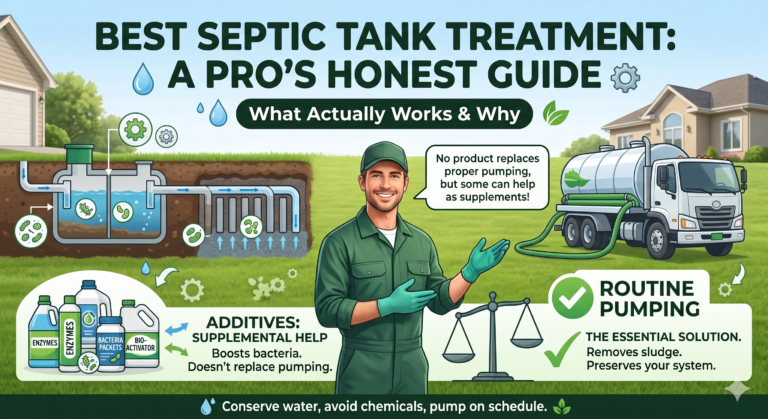
For most households, a monthly maintenance dose of beneficial microorganisms is a reasonable insurance policy — but no additive replaces routine pumping. Among the popular options, here’s the short version from someone who’s opened a lot of tanks:
- Rid-X — the most widely available, dry-powder option with both enzymes and bacterial strains. Convenient, easy to dose, broadly trusted.
- Green Gobbler — concentrated, often pitched for both septic and drain/grease applications; useful if you also fight kitchen buildup.
- Cabin Obsession — a freeze-dried bacteria product aimed at seasonal cabins, vacation homes, and lightly used systems.
Bottom line: Treatments support a healthy bacterial population; they do not dissolve the sludge layer enough to skip your pump-out interval. Pick based on your usage pattern, not marketing claims.
Do septic tank treatments additives actually work?
Let me be straight with you, because this is where the marketing and the field reality part ways. A septic system is a living wastewater treatment process. Inside the tank, anaerobic bacteria break down the organic solids that settle into the sludge layer at the bottom, while fats and oils float up to form the scum layer on top. The relatively clear effluent in the middle flows out through the baffle, into the distribution box, and out to the drainfield, where soil percolation finishes the job.
Here’s the thing: a normally functioning household tank already grows its own beneficial microorganisms. Every flush seeds it. So the honest question isn’t “do additives create magic bacteria?” — it’s “does my system have a shortfall worth supplementing?”
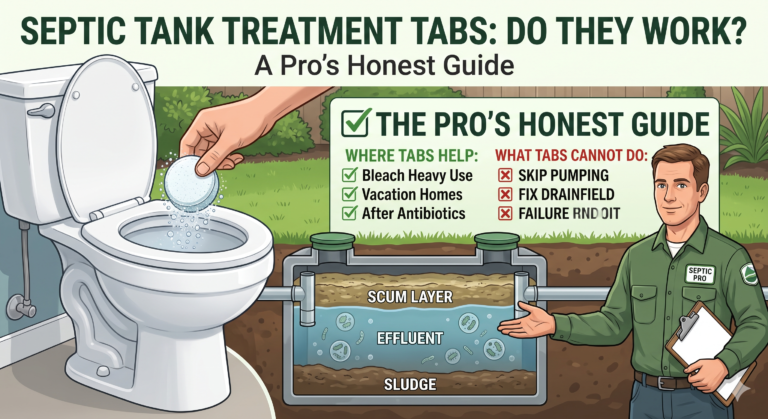
The answer depends on your household. Septic tank additives are most useful when:
- Your system sees heavy household chemical interference — bleach, antibacterial cleaners, harsh drain openers — that can knock back your native bacteria.
- The home is used seasonally, so the bacterial colony dies back between visits (this is exactly the cabin scenario).
- You’ve recently had antibiotics in the household or a big chemical event and want to help the population rebound.
What additives cannot do: they cannot meaningfully reduce a deep sludge layer, they cannot rescue a failing leach field, and they cannot extend your pump-out interval to the point of skipping it. If a label implies otherwise, read it skeptically. For the full picture on routine care, see our complete septic treatment guide.
How do enzymes and bacteria treatments work inside the tank?
Most septic tank additives fall into two camps, and a few combine them:
- Enzyme-based: Enzymes are not alive — they’re catalysts that help break larger molecules (fats, proteins, starches) into smaller pieces. Enzyme colonies in a product give bacteria an easier head start, but enzymes alone don’t reproduce.
- Bacteria-based: These deliver live or freeze-dried bacteria — multiple bacterial strains — that wake up in the tank and join the existing population. Both anaerobic bacteria (which dominate the tank) and, in some products, facultative or aerobic bacteria are included.
Freeze-dried bacteria is a clever delivery method: the microorganisms are dormant and shelf-stable in the package, then rehydrate and activate once they hit the wastewater. That’s why it shows up so often in cabin and seasonal products — you can store it, then “recharge” the system after a long vacancy.
A quick distinction worth knowing: a conventional septic tank runs an anaerobic (no-oxygen) process. Aerobic bacteria need oxygen and are the workhorses of an aerobic treatment unit (ATU) or activated sludge process — a different, more mechanical system. Dumping aerobic strains into a sealed anaerobic tank doesn’t transform it into an aerobic system; the environment dictates what thrives.
Rid-X vs Green Gobbler vs Cabin Obsession: side-by-side comparison
These three cover the three most common buyer situations: the everyday convenience pick, the dual-purpose drain-and-septic pick, and the seasonal-cabin pick. Here’s how I’d frame them for a customer standing in their driveway.
| Feature | Rid-X | Green Gobbler | Cabin Obsession |
|---|---|---|---|
| Primary use | General monthly septic maintenance | Septic + drains/grease buildup | Seasonal / lightly-used systems |
| Form | Dry powder (also pods/liquid variants) | Concentrated liquid/granular variants | Freeze-dried bacteria packs |
| Contains | Enzyme colonies + multiple bacterial strains | Enzymes + beneficial microorganisms | Dormant bacterial strains for recharge |
| Best for | Full-time homes, easy routine | Homes also fighting kitchen grease | Cabins, vacation homes, RVs/rare use |
| Dosing rhythm | Monthly treatment | Per-label, often monthly | On arrival/departure + periodic |
| Availability | Very wide (big-box, grocery) | Wide (online + retail) | Mostly online |
Note: Product formulations and packaging change. Always follow the dosing on the label you actually buy, and match the dose to your tank capacity gallons — a 1,000-gallon tank and a 1,500-gallon tank are not the same animal.
Septifix
Managing an older, more fragile septic system requires a proactive approach. See why this simple monthly tablet routine is gaining traction for waste digestion and odor control. Can a simple monthly tablet really protect an aging septic system? For homeowners looking to proactively control odors and manage waste, this routine is worth exploring.
Check: Septifix Septic Tank Treatment Tabs →
Rid-X — the easy default
If you want a no-fuss monthly habit and you’ll forget anything complicated, this is the path of least resistance. It blends enzyme colonies with bacterial strains, and it’s available almost everywhere, which matters because consistency beats occasional perfection. For a typical full-time household that pumps on schedule, a once-a-month dose is a sensible baseline.
It’s the option I point first-time septic owners toward when they ask “what do I just buy and not think about.”
Green Gobbler — when grease is your real enemy
If your slow drains and odors trace back to the kitchen, a product that works on both your lines and your tank earns its place. Homes without a dedicated grease trap tend to push a lot of fats into the system, thickening the scum layer faster than usual. A concentrated dual-purpose treatment can help keep lines moving while supporting the tank’s microorganisms.
Cabin Obsession — built for systems that sit empty
This is the one most people get wrong by reaching for a full-time product. A cabin or vacation home’s bacterial population crashes during long vacancies because there’s nothing feeding it. Freeze-dried bacteria let you “recharge” the colony when you arrive and again when you leave. If your place is dark for weeks at a stretch, a seasonal-formulated product makes more sense than a general monthly powder.
What do EPA guidelines and standard practice say about additives?
Regulators and most extension-service guidance land in a consistent, cautious place: the foundation of septic care is regular inspection and pumping, smart water use, and protecting the drainfield — not additives. EPA guidelines emphasize that a properly designed and maintained system grows the bacteria it needs on its own. Additives are treated as optional, not as a substitute for maintenance. (For regulatory context, see the EPA Septic Systems Overview.)
I’d put it this way: think of treatments like a multivitamin, not a meal. They may help around the edges, especially after a chemical hit or a long vacancy, but they don’t feed the system the way routine pumping and sane habits do.
One genuine caution: avoid any product that promises to “eliminate the need to pump.” Solids accumulate no matter what — that’s physics, not biology. Skipping pump-outs is how clogged baffles, backed-up effluent, and ruined drainfields happen.
How does an additive fit into your overall pump-out interval?
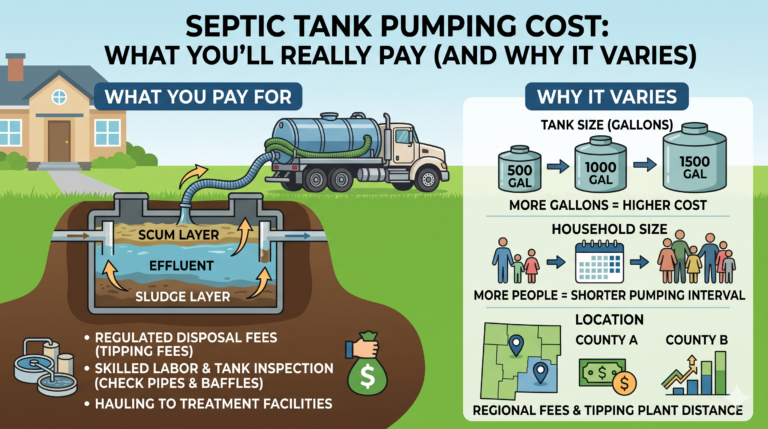
Your pump-out interval is driven by three things: tank capacity gallons, number of people in the house, and how much solid load you generate. The accumulation of the sludge layer (bottom) and scum layer (top) is what eventually shrinks your usable settling space. When those layers crowd the middle, solids escape past the baffle, travel through the distribution box, and start clogging the soil pores of the leach field. That’s the expensive failure.
A reasonable general rhythm for many households is an inspection every couple of years and pumping when the combined sludge and scum reach the threshold a technician measures. Additives don’t change that math much; they support biology, not the laws of accumulation.
- Bigger tank, fewer people: longer interval between pump-outs.
- Smaller tank, full house, garbage disposal: shorter interval.
- Heavy chemical use or recent system overload: inspect sooner; consider supporting the bacteria after the event.
What hurts septic bacteria — and what helps?
If you want your beneficial microorganisms to thrive, the cheapest and most effective “treatment” is to stop killing them. Here’s the practical list I give every homeowner.
Things that hurt your system
- Household chemical interference: bleach, drain openers, antibacterial everything in large amounts.
- Hydraulic loading spikes: running every load of laundry on the same day floods the tank and pushes solids out before they settle. Spread out water use.
- System overload: too many people for the tank, or excessive water, leads to short settling time and a saturated drainfield.
- Grease and fats: they thicken the scum layer and can migrate to the field. Scrape plates; consider a grease trap if your kitchen runs hot.
- Non-degradables: wipes (even “flushable”), feminine products, paper towels, cat litter.
Things that help
- Stagger laundry and dishwashing to keep hydraulic loading even.
- Fix leaky fixtures — a running toilet alone can drown a drainfield.
- Keep roots, vehicles, and heavy structures off the drainfield so soil percolation stays healthy.
- Use septic-safe cleaners and dose treatments per label after any big chemical event.
What about the biomat, cesspools, and the drainfield?
People conflate a few things here, so let me untangle them.
The biomat is a thin biological layer that naturally forms where effluent meets soil in the drainfield (also called the leach field). A healthy biomat helps treat wastewater as it percolates — but if effluent carries too many solids (from a tank that’s overdue for pumping), the biomat thickens and clogs, and the field stops accepting water. No additive reliably reverses a heavily clogged biomat; that’s a maintenance and sometimes a repair issue.
A cesspool is an older design — essentially a pit that lets liquid seep directly into the ground without the separation a modern tank provides. Cesspools are being phased out in many areas and don’t behave like a tank-and-drainfield system; treatments are even less of a fix there. If you have one, talk to a pro about your options.
If your problem is the drainfield, no amount of bacteria in the tank will save it — the issue is downstream of where additives work.
How should you actually use a septic treatment? (Step-by-step)
- Confirm your tank capacity gallons. Check your permit/record or ask your pumper. Dose to size.
- Read the specific label. Formulations differ; don’t guess from a different product’s instructions.
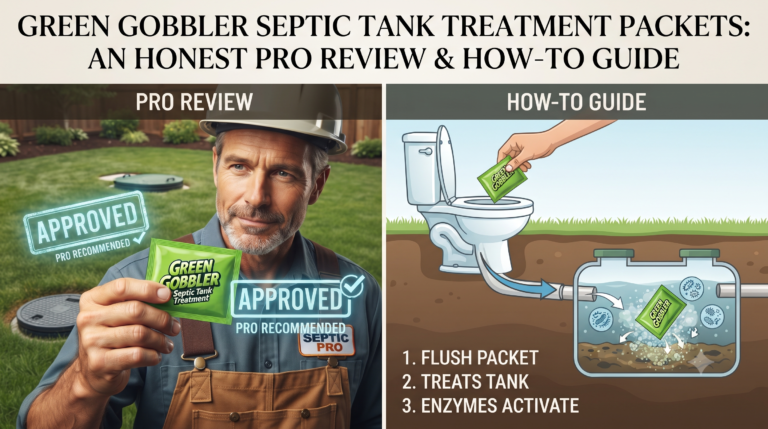
- Apply at the lowest-traffic drain, typically a toilet, so it reaches the tank without sitting in a sink.
- Flush it down with water, then avoid heavy chemical use for the next day so the new bacterial strains can establish.
- Set a monthly treatment reminder for full-time homes, or an arrival/departure routine for cabins.
- Track your pump-out interval separately. Treatment is in addition to pumping, never instead of it.
When should you call a professional?
Call a licensed septic professional — not the additive aisle — when you see any of these:
- Sewage odors indoors or pooling water/lush green patches over the drainfield.
- Slow drains or gurgling throughout the house at once (suggests tank or line, not a single clog).
- Backups after rain, which often point to a saturated field or hydraulic overload.
- It’s been longer than a couple of years since an inspection, or you don’t know your last pump-out date.
- You suspect a clogged baffle, a failed distribution box, or a clogged biomat.
A pro can measure your sludge and scum layers, inspect the baffle and distribution box, and tell you whether you have a biology problem (rare) or an accumulation/hydraulic problem (common). That diagnosis saves far more than a year of additives.
FAQ
Can septic treatments replace pumping?
No. Solids accumulate as a sludge layer regardless of how healthy your bacteria are. Treatments support the biology; pumping removes the physical solids. Any product claiming to eliminate pumping should be treated with deep skepticism — skipping pump-outs risks your drainfield and a very expensive repair.
Is Rid-X or Green Gobbler better?
It depends on the job. Rid-X is the simple monthly maintenance default for full-time homes. Green Gobbler suits households that also fight kitchen grease and slow drains because it’s often pitched as a dual drain-and-septic product. For a seasonal cabin, neither beats a freeze-dried recharge product like Cabin Obsession. Match the product to your usage pattern.
How often should I add septic treatment?
For full-time households, a monthly treatment is a common rhythm — but follow your product’s label and dose for your tank capacity gallons. For cabins and vacation homes, a recharge dose on arrival and again before you leave usually makes more sense than a fixed monthly schedule.
Do additives help an aerobic or activated sludge system?
A conventional tank is anaerobic; aerobic treatment units and activated sludge processes are different and rely on oxygen-driven aerobic bacteria. Dumping anaerobic-targeted additives into an aerobic system — or vice versa — won’t change the environment. If you have an ATU, follow the manufacturer’s and your service contract’s guidance rather than a generic tank additive.
The honest takeaway
The best septic tank treatment for 2026 is the one that fits your real usage and gets used consistently — Rid-X for everyday convenience, Green Gobbler when grease is the issue, Cabin Obsession for systems that sit empty. But treatments are a supporting player. Regular pumping, even water use, protecting the drainfield, and easing off household chemicals do far more for your system than anything you pour down the drain. Treat the biology, respect the physics, and call a pro the moment symptoms point downstream of the tank.