Bio-Clean vs Septifix: Which Suits Your System?
Bio-Clean occupies an unusual position in this category. It is sold as a bacteria-and-enzyme product for household drains and septic systems, which makes it appealing if you have both a sluggish kitchen line and a tank to look after. It also makes it harder to compare directly against products built for one job.
This guide covers what Bio-Clean is, how the dual-purpose positioning plays out in a real household, and how it compares with a dedicated monthly septic tablet like Septifix.
Quick answer: Bio-Clean is a drain-and-septic crossover product. If your priority is the tank rather than the kitchen line, a dedicated monthly septic routine is the more focused choice, and a pre-measured tablet is the format most people stay consistent with. Septifix is our featured option to compare first.
What Bio-Clean is
Bio-Clean is a powdered blend of bacteria and enzymes, activated in water and poured into a drain. The marketing emphasis is on digesting the organic build-up that coats the inside of pipes — soap film, grease, hair, food residue — as well as supporting the biological activity inside a septic tank.
Mechanically this is the same principle as every other product discussed on this site: introduce organisms and enzymes that break down organic material. The distinguishing feature is application. Bio-Clean is intended to be poured into a drain and left overnight so it has contact time with the pipe walls, rather than flushed straight through to the tank.
The dual-purpose question
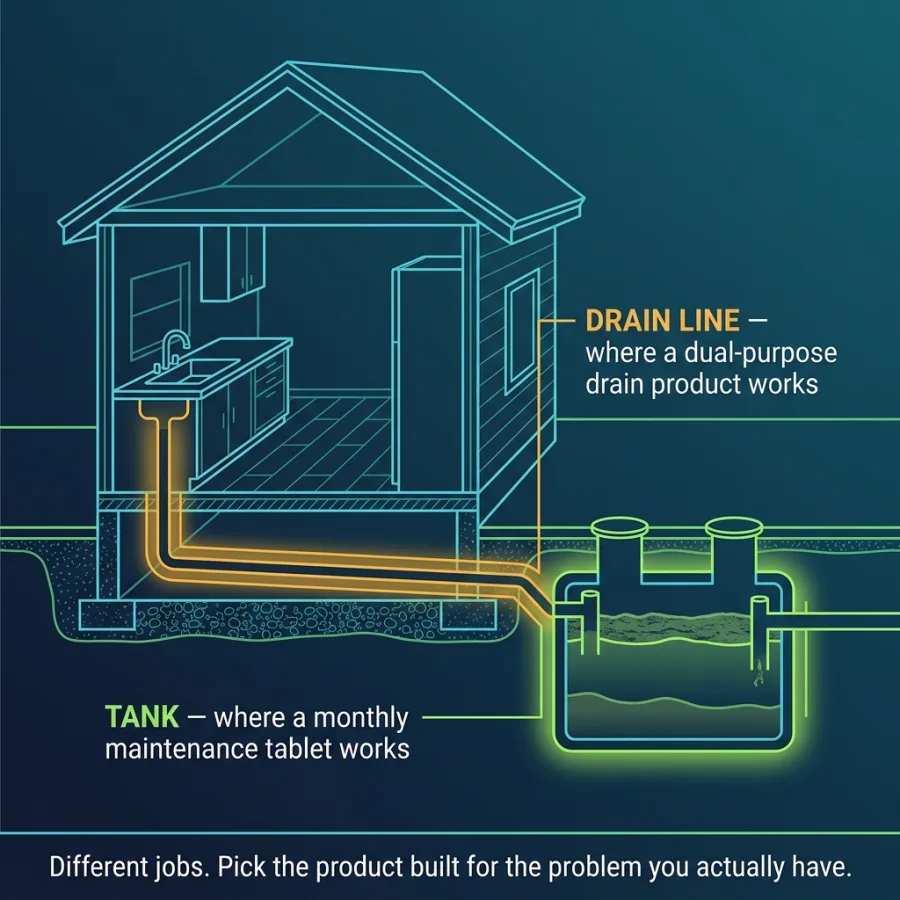
A product that treats both drains and the tank sounds efficient, and for some households it is. But the two jobs pull in different directions:
- Drain treatment wants contact time on pipe walls. That means dosing at night, no water use afterwards, and repeat applications on the specific problem line.
- Tank maintenance wants material delivered into the tank on a predictable monthly cycle, dose matched to tank volume.
You can serve both, but the routine becomes more demanding: the right drain, the right night, no showers afterwards. Households that succeed with Bio-Clean tend to be ones with a specific, recurring slow-drain complaint that justifies the extra effort. Households that simply want the tank looked after usually find a monthly flush-and-forget routine easier to sustain.
What every septic additive can and cannot do
The U.S. Environmental Protection Agency sets out routine inspection, water efficiency, drain-field care and pumping — not additives — as the foundation of septic maintenance. Read the EPA’s guidance on caring for your septic system before deciding how much any product can be expected to do.
Before comparing brands it is worth being blunt about the category, because it saves money and disappointment. A septic additive is a dose of bacteria, enzymes, or both. Its job is to support the biological breakdown that is already happening inside a working tank.
What no additive on the market can do:
- Replace pumping. Solids accumulate as sludge at the bottom and scum at the top. Bacteria do not remove that layer from the tank. Only a pump truck does. The U.S. EPA’s guidance for homeowners is to have a typical household system inspected roughly every three years and pumped on a schedule set by tank size and household size — commonly every three to five years.
- Repair hardware. A collapsed baffle, a crushed inlet pipe, a failed pump, or a root-invaded line is a physical problem with a physical fix.
- Rescue a saturated drain field. If effluent is surfacing in the yard or backing into the house, that is an inspection call, not a shopping decision.
What an additive can reasonably contribute is consistency: a routine, monthly habit that keeps the biological side of a normally functioning tank topped up between scheduled pump-outs. Independent evidence that additives measurably extend pumping intervals is limited, and you should treat any product claiming otherwise with suspicion — including claims made about the product on this page.
That framing matters for the comparison below, because once you accept that every product in this category is doing broadly the same job, the deciding factors become narrow and practical: dosing format, how easy it is to stay consistent, cost per month, and whether the label matches your tank size.
Where Bio-Clean makes sense
- You have a genuine slow-drain issue in a kitchen or bathroom line, and you would otherwise reach for a caustic drain opener — which is the worst thing you can put into a septic system.
- You want one product rather than separate drain and tank routines, and you are realistic about the application requirements.
- You are replacing chemical drain cleaners. This is a genuine win for the tank regardless of which biological product you choose.
Where it falls short
- Application burden. Overnight dwell time and no water use afterwards is a real constraint in a busy household, and skipped applications are the norm rather than the exception.
- Measuring. As with any powder, the dose is only as accurate as the person with the scoop.
- Cost per treatment. It generally sits at the higher end of the category, which is easier to justify for an active drain problem than for routine tank upkeep.
- Split focus. If the tank is your actual concern, you are paying for pipe-wall performance you do not need.
Bio-Clean compared with Septifix
| Bio-Clean | Septifix | |
|---|---|---|
| Job | Drains plus tank | Tank only |
| Routine | Overnight application, no water use | Flushed and forgotten |
| Dosing | Measured powder | Pre-measured tablet |
| Cost framing | Typically bought per problem | Bought as a multi-month supply |
| Best suited to | A stubborn drain line | Routine tank maintenance |
- Job. Bio-Clean is drains plus tank. Septifix is tank only. Neither approach is wrong — it depends which problem you actually have.
- Routine. Bio-Clean asks for an overnight application with no water use. Septifix is flushed and forgotten. For monthly maintenance stretched over years, the lower-friction routine is the one that survives.
- Dosing. Measured powder versus a pre-measured tablet — the tablet removes a decision.
- Cost framing. Bio-Clean is typically bought per problem; Septifix as a multi-month supply. Compare cost per month, not per container.
If you have a stubborn kitchen line, Bio-Clean is solving a problem a septic tablet does not address. If your drains are fine and you simply want the tank on a routine, the crossover product is doing work you are not benefiting from.
Frequently asked questions
Can Bio-Clean replace pumping?
No. Nothing in this category removes sludge and scum from the tank. Stay on your pumping schedule, generally every three to five years depending on tank size and household size.
Is Bio-Clean better than a caustic drain opener for a septic system?
For the health of your tank, yes — biological products avoid dumping harsh chemistry into a system that depends on living bacteria. That is true of the whole category, not this brand specifically.
Can I use Bio-Clean and a septic tablet together?
Technically yes, since they target different places, but there is limited value in running two overlapping products. Decide whether your real problem is drains or the tank, and address that one properly.
Why does it need to sit overnight?
Because drain treatment depends on contact time with the pipe wall. Running water immediately afterwards washes the product through to the tank before it has done the job you bought it for.
Does it work on a fully blocked drain?
No. A complete blockage needs mechanical clearing. Biological products are for maintenance and slow build-up, not emergencies.
The bottom line
Bio-Clean is a competent product aimed at a slightly different problem than most septic additives. Choose it if you have an active drain complaint you want to solve without harsh chemicals.
If your goal is straightforward tank maintenance between pump-outs, a dedicated monthly tablet is the lower-friction routine, and low friction is what keeps a maintenance habit alive past the first three months.
Quick answer: Drain problem, or tank maintenance? Answer that first, then pick the product built for that job — and keep pumping on schedule either way.
Related comparisons
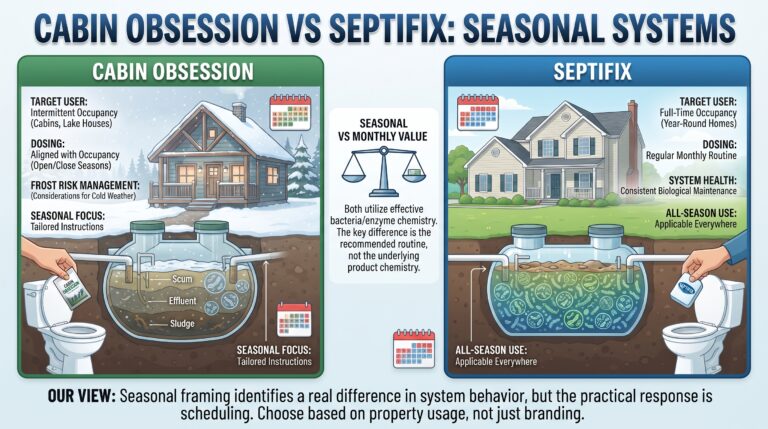
- Cabin Obsession vs Septifix
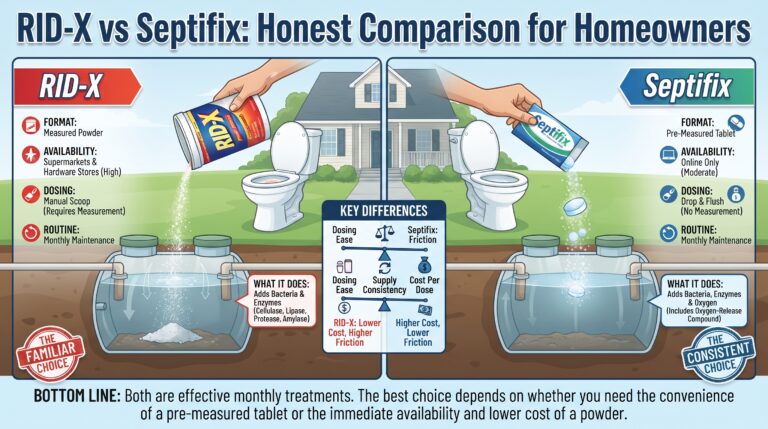
- RID-X vs Septifix
- Instant Power Septic Shock vs Septifix
- Best septic tank treatment: the full guide
- Septic additives vs pumping: what actually works
Essential septic guides
Affiliate disclosure: This guide contains affiliate links, including our Septifix partner link. If you purchase through one of these links, we may earn a commission at no additional cost to you. Our conclusions are based on product information and published guidance, not payment level.