RID-X vs Septifix: Honest Comparison for Homeowners
RID-X is the product most people picture when they hear “septic treatment.” It sits on the shelf in every hardware store and supermarket in the country, it is inexpensive, and it has been sold for decades. That familiarity is worth something — but it is not the same thing as being the right fit for your household.
This comparison looks at what RID-X contains, how it is dosed, where it genuinely helps, where it is oversold, and how it stacks up against a monthly tablet routine such as Septifix.
Quick answer: If you want the short version: RID-X and Septifix are the same category of product doing broadly the same job. The practical difference is format and consistency. RID-X is cheap and everywhere; a pre-measured monthly tablet is harder to forget and easier to dose correctly. Neither replaces pumping. Septifix is our featured option to compare first.
What is in RID-X?
RID-X is an enzyme-and-bacteria product. Its formulations centre on a group of enzymes chosen to target the main categories of household waste that reach a septic tank:
- Cellulase — targets cellulose, which in practice means toilet paper and other plant-fibre material.
- Lipase — targets fats, oils and grease.
- Protease — targets proteins.
- Amylase — targets starches.
Alongside the enzymes, the product carries bacterial cultures intended to continue breaking material down after the enzymes have started the process. This combination is not unusual: it is close to the standard recipe across the whole additive category, which is one reason brand-versus-brand arguments tend to generate more heat than light.
How RID-X is dosed
RID-X is sold in several formats — powder, gel packs, and tablets — and the intended routine is monthly, flushed down a toilet. Dosing is typically scaled to tank size, and this is where the most common user error appears: people buy one container, use the same scoop regardless of tank capacity, and either underdose a large tank or overdose a small one.
If you do not know your tank size, find it before you buy anything. It is usually on the original permit or the septic record held by your county health department, and it changes the correct dose for every product in this category, not just this one.
What every septic additive can and cannot do
The U.S. Environmental Protection Agency sets out routine inspection, water efficiency, drain-field care and pumping — not additives — as the foundation of septic maintenance. Read the EPA’s guidance on caring for your septic system before deciding how much any product can be expected to do.
Before comparing brands it is worth being blunt about the category, because it saves money and disappointment. A septic additive is a dose of bacteria, enzymes, or both. Its job is to support the biological breakdown that is already happening inside a working tank.
What no additive on the market can do:
- Replace pumping. Solids accumulate as sludge at the bottom and scum at the top. Bacteria do not remove that layer from the tank. Only a pump truck does. The U.S. EPA’s guidance for homeowners is to have a typical household system inspected roughly every three years and pumped on a schedule set by tank size and household size — commonly every three to five years.
- Repair hardware. A collapsed baffle, a crushed inlet pipe, a failed pump, or a root-invaded line is a physical problem with a physical fix.
- Rescue a saturated drain field. If effluent is surfacing in the yard or backing into the house, that is an inspection call, not a shopping decision.
What an additive can reasonably contribute is consistency: a routine, monthly habit that keeps the biological side of a normally functioning tank topped up between scheduled pump-outs. Independent evidence that additives measurably extend pumping intervals is limited, and you should treat any product claiming otherwise with suspicion — including claims made about the product on this page.
That framing matters for the comparison below, because once you accept that every product in this category is doing broadly the same job, the deciding factors become narrow and practical: dosing format, how easy it is to stay consistent, cost per month, and whether the label matches your tank size.
Where RID-X genuinely makes sense
There is a real case for RID-X, and it is worth stating plainly rather than dismissing a product simply because we recommend an alternative:
- Cost and availability. It is among the cheapest options in the category and you can buy it locally today without waiting for shipping.
- Familiarity. If a member of your household already uses it and the routine is established, the value of an established routine is genuinely higher than a marginal formulation difference.
- Low commitment. A single small container is an easy way to start a monthly habit without committing to a larger supply.
Where RID-X falls short
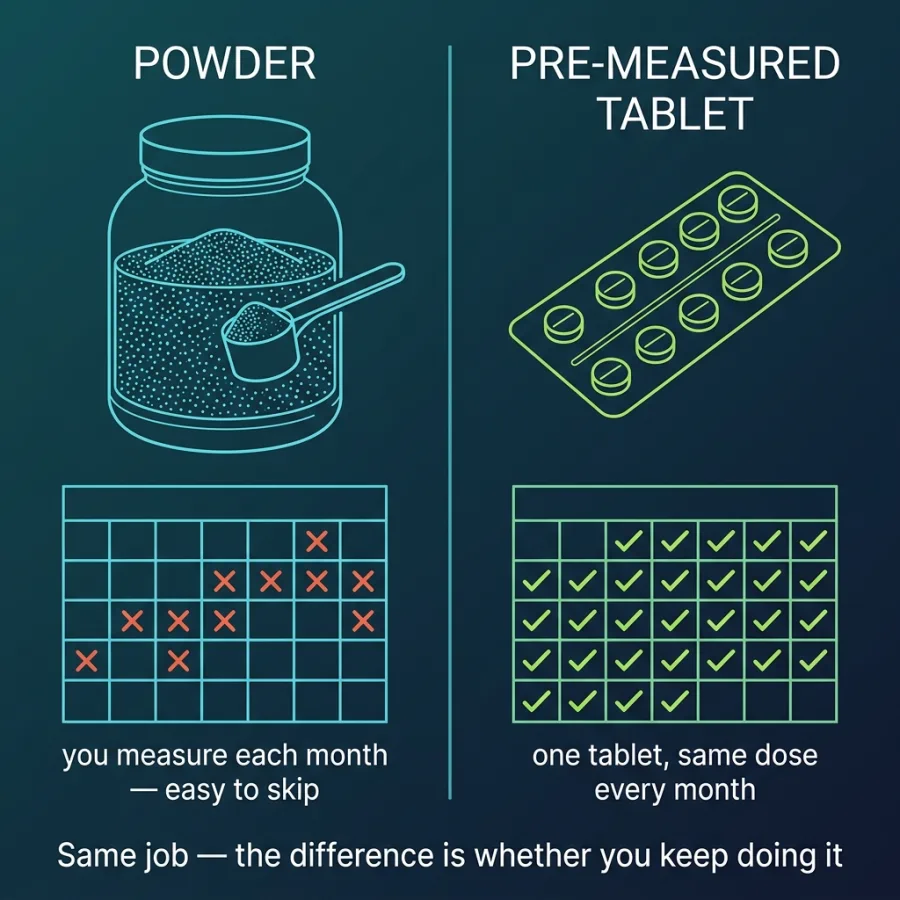
- Dosing friction. Powder that has to be measured is powder that gets measured wrong, or skipped. The gel and tablet formats reduce this, but the powder remains the most widely sold version.
- The claims problem. The category as a whole has a long history of implying that regular use reduces the need for pumping. It does not, and no reputable septic professional will tell you otherwise.
- Buying cadence. A small container bought at the supermarket runs out quietly, and the routine tends to lapse with it.
RID-X compared with Septifix
| RID-X | Septifix | |
|---|---|---|
| Format | Measured powder | Pre-measured tablet |
| Supply length | Bought a container at a time | Sold in multi-month packages |
| Availability | On a shelf near you | Ordered online |
| Cost per month | Cheaper per dose | Higher per dose |
| Dosing consistency | You measure each month | Pre-measured, removing wrong quantity and skipped months |
Both products are monthly maintenance additives combining bacteria and enzymes. The differences that actually affect a homeowner:
- Format. RID-X is most commonly a measured powder; Septifix is a pre-measured tablet. Pre-measured formats remove the two most common dosing mistakes — wrong quantity and skipped months.
- Supply length. RID-X is typically bought a container at a time. Septifix is sold in multi-month packages, which front-loads the cost but makes it far more likely the routine survives to month six.
- Availability. RID-X wins outright — it is on a shelf near you. Septifix is ordered online.
- Cost per month. RID-X is cheaper per dose. Whether that matters depends on whether the cheaper product actually gets used every month.
Our position is not that RID-X is a bad product. It is that the single biggest predictor of whether an additive does anything useful is whether you are still dosing it a year from now, and pre-measured multi-month supplies win that contest more often than a supermarket tub does.
Frequently asked questions
Does RID-X reduce how often I need to pump my tank?
No. No additive removes accumulated sludge and scum from the tank. Keep to the pumping schedule appropriate for your tank size and household, generally every three to five years, with inspection roughly every three years.
Can RID-X unclog a drain or fix a backup?
No. A backup or a surfacing drain field is a physical or hydraulic problem. Call a licensed septic professional; do not attempt to treat it with an additive.
Is RID-X safe for my system?
Products in this category are formulated for septic use and are not the risk that harsh chemical drain openers pose. The greater risk to your tank is what else goes down the drain — bleach in volume, solvents, wipes, and grease.
Can I use RID-X and another treatment together?
There is no benefit to doubling up, and it makes it impossible to tell what is doing what. Pick one product, dose it correctly for your tank size, and stay consistent.
How long before I notice anything?
Honestly, you should not expect a dramatic, observable change in a normally functioning system — that is the point of preventive maintenance. If you are hoping a product will fix a symptom you can smell or see, that symptom needs diagnosing first.
The bottom line
RID-X is a reasonable, cheap, widely available product in a category where brand differences are smaller than marketing suggests. If you already use it and dose it correctly for your tank size every month, there is no urgent reason to switch.
If your problem is consistency — a tub in the garage you last opened in spring — then the format is your real enemy, not the brand. A pre-measured monthly tablet bought as a multi-month supply is the version of this habit most people actually keep.
Quick answer: RID-X and Septifix occupy the same shelf and do the same job. Choose on format and consistency, dose for your tank size, and keep pumping on schedule regardless.
Related comparisons
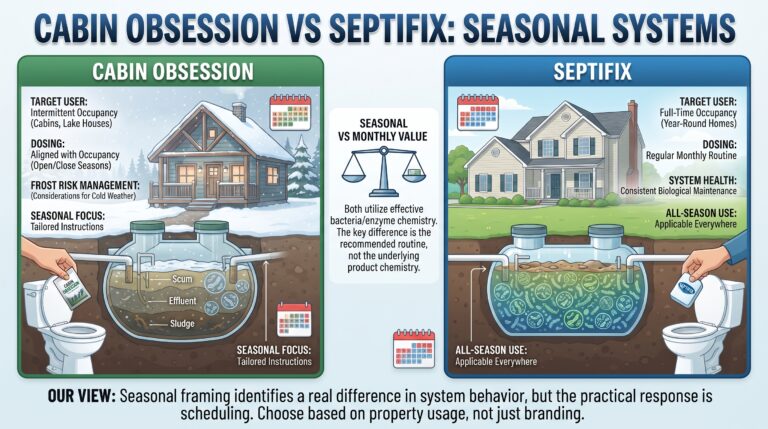
- Cabin Obsession vs Septifix
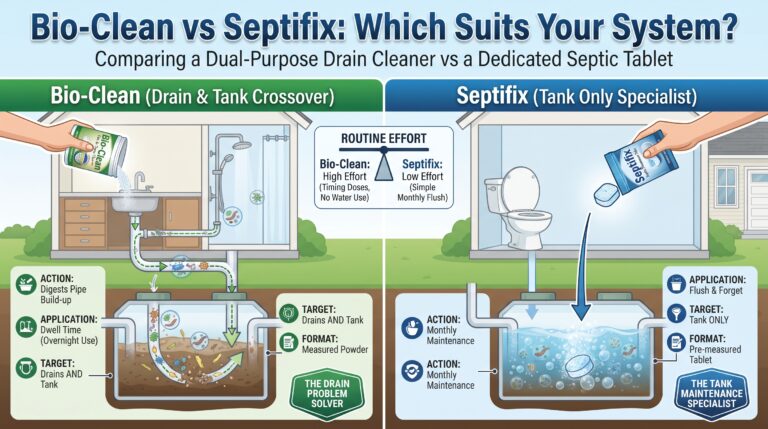
- Bio-Clean vs Septifix
- Instant Power Septic Shock vs Septifix
- Best septic tank treatment: the full guide
- Septic additives vs pumping: what actually works
Essential septic guides
Affiliate disclosure: This guide contains affiliate links, including our Septifix partner link. If you purchase through one of these links, we may earn a commission at no additional cost to you. Our conclusions are based on product information and published guidance, not payment level.