Septifix Tablets Review 2026: What the Evidence Actually Supports
Septifix tablets are marketed as a once-a-month, drop-in septic treatment that releases oxygen, seeds the tank with aerobic bacteria, and reduces odour and sludge build-up. The product sits at the premium end of a crowded category, and the search results for it are unusually noisy — most of the pages ranking for “Septifix” are the seller’s own network of near-identical landing pages.
This review is our attempt to give you the other thing: a plain assessment of what the product claims, what septic science actually supports, and where a monthly tablet stops being useful no matter how good the formula is.
What this review is — and what it is not
We want to be straight with you about our method, because it changes how much weight you should give what follows.
We have not physically tested Septifix in a septic system. We have not dosed a tank for six months, pulled sludge measurements, or run before-and-after inspections. Any review that claims to have done so on a residential system should be read carefully — meaningful additive testing requires controlled sludge-depth measurement over a period of months, and almost nobody publishing affiliate reviews is doing that.
What this assessment is based on:
- The manufacturer’s own published specifications and claims
- Guidance from the US EPA on septic system care and additives
- University extension research on why septic systems fail and what additives can and cannot do
- Direct comparison against the other products in this category that we cover
That gives you a documentation-based verdict, not a field trial. It is honest about its limits, and it is enough to answer the question most homeowners are actually asking: is this worth my money, or am I better off spending it elsewhere?
What Septifix tablets actually are
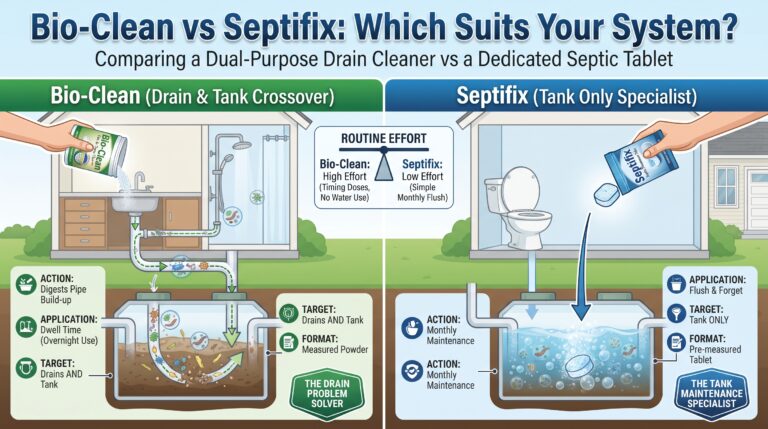
Septifix is a tablet-format septic tank treatment. You flush one down the toilet on a monthly schedule and it dissolves in the tank. The manufacturer’s published positioning centres on three mechanisms:
- Oxygen release. The tablets are described as releasing oxygen as they dissolve, which is the differentiator the brand leans on hardest — most competing products do not claim this.
- Aerobic bacterial strains. The formula is advertised as containing multiple strains of bacteria at a high colony-forming-unit count per gram.
- pH balancing compounds. Intended to keep tank conditions within a range where bacteria stay active.
The stated benefits follow from those: faster breakdown of organic solids, reduced odour, and — the claim that sells the product — longer intervals between pump-outs.
Format matters more than homeowners expect. A pre-measured tablet removes the two ways people get dosing wrong with powders and liquids: guessing the quantity, and forgetting entirely. That convenience is real, and it is the strongest honest argument for this product category. It is also the argument we make in our best septic tank treatment guide for 2026, where Septifix is compared side by side against six alternatives.
The oxygen mechanism, and why it is plausible
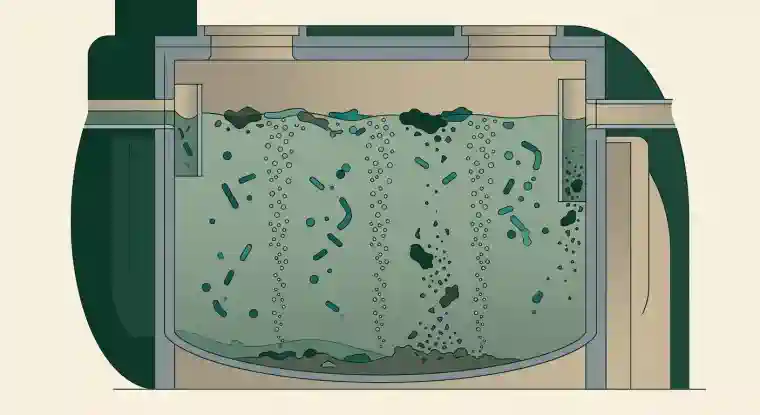
The reasoning behind an oxygen-releasing tablet is sound in principle. A conventional septic tank is an anaerobic environment: it operates without oxygen, and the bacteria that break down waste in it work slowly as a result. Aerobic bacteria — the kind that need oxygen — digest organic matter considerably faster. That is precisely why engineered aerobic treatment units exist as an upgrade over conventional tanks, and why they cost several thousand dollars to install.
So the concept is not pseudoscience. The open question is one of scale.
A residential septic tank typically holds 1,000 to 1,500 gallons. A monthly tablet is introducing a finite quantity of oxygen and bacteria into that volume, in a system that is continuously receiving new wastewater and flushing liquid out to the drain field. A purpose-built aerobic unit maintains oxygenation continuously with a powered aerator. A tablet cannot replicate that, and the manufacturer does not claim it converts your tank into an aerobic system.
The honest read: the mechanism is directionally real, the magnitude is unproven at the dose involved, and no independent peer-reviewed study establishes how much difference it makes in a working residential tank. Treat any specific promise about extending your pumping interval as a marketing claim, not an established figure.
Where the regulators and researchers land on additives
This is the part most reviews of this product skip, and it is the part that should shape your decision most.
The EPA’s guidance on septic care does not recommend additives as part of normal domestic wastewater treatment. A healthy septic tank already receives all the bacteria it needs from ordinary household waste — the bacterial population is self-sustaining under normal use. Washington State University’s extension guidance is more pointed still, warning against treating additives as a substitute for pumping. North Carolina State’s work on septic failure identifies the actual causes: hydraulic overloading, poor maintenance, design limitations, and physical damage.
Notice what is absent from that list: insufficient bacteria. Systems overwhelmingly fail because too much water goes through them, because solids were never pumped out, or because something is physically broken — not because the microbial population ran short.
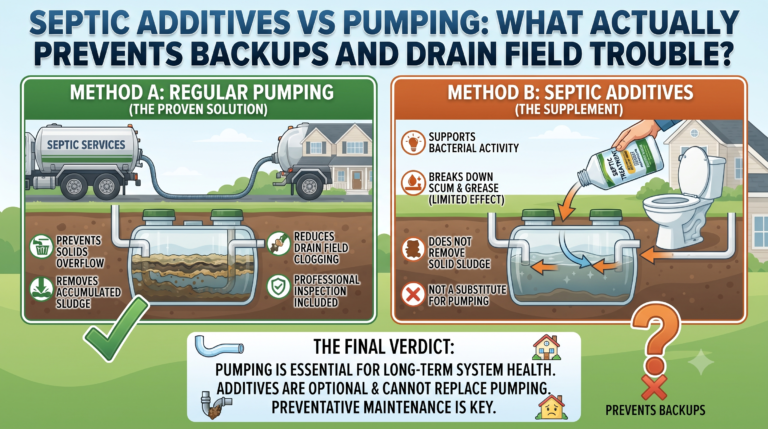
That does not make Septifix worthless. It does mean the product is addressing a problem that is rarely the binding constraint on a septic system’s health. We wrote about this trade-off in more depth in septic additives vs pumping, and the conclusion there holds here.
How to tell whether your tank needs anything at all
Before spending money on any additive, it is worth establishing what state your tank is actually in. This is measurable, and the measurement is the thing that should drive your decisions — not a product’s marketing.
Two numbers matter, and a septic professional will record both at every pump-out:
- Sludge depth. The settled solids at the bottom of the tank. The widely used rule of thumb is that the tank needs pumping when sludge occupies roughly one third of its depth.
- Scum thickness. The floating layer of fats, oils and grease at the top. When it approaches the bottom of the outlet baffle, material starts escaping toward the drain field — which is the expensive failure mode.
Both are checked with a sludge judge or a simple weighted stick lowered through the access port. If you have never had these recorded, ask for the figures at your next pump-out and write them down with the date. Two consecutive measurements tell you your household’s actual accumulation rate, which is far more useful than any general schedule.
This matters for the Septifix question specifically. If your measurements show a normal accumulation rate for your household size and tank volume, your bacterial population is doing its job and an additive has little room to improve on it. If your sludge is accumulating unusually fast, the cause is almost always what is going down the drain or how much water is going through — and those are behavioural fixes, not dosing fixes. Either way, the measurement tells you more than the product label does. Our septic tank maintenance checklist covers what else to record.
What no tablet can do

This is the single most important section of this review, so we will be blunt about it.
Bacteria digest organic material. They do not digest the inorganic solids, grit, and non-biodegradable material that accumulate in every tank. That material builds up as sludge at the bottom and scum at the top, and the only way it leaves your tank is on a pump truck. A tablet cannot remove it, reduce it below a floor, or make the pump-out unnecessary.
Septifix also cannot:
- Repair a failing drain field. Once a field is saturated or clogged with biomat, that is an excavation problem, not a dosing problem.
- Fix broken components. Collapsed baffles, cracked pipes, or a failed pump need a contractor.
- Compensate for hydraulic overload. If you are pushing more water through the system than it was sized for, no additive changes the arithmetic.
- Resolve an active backup. Sewage backing up into the house is an emergency. Call someone.
- Undo skipped maintenance. A tank that is years overdue for pumping needs pumping.
If you are considering Septifix because you have noticed odours, slow drains, or wet patches over the drain field, stop and read the warning signs of a failing septic system first. Buying a treatment while ignoring a genuine fault is the most expensive mistake in this category — you delay the real repair and the damage compounds.
How Septifix compares to the alternatives
Format and dosing discipline are where the meaningful differences sit. Here is how the main options line up:
| Product | Format | Dosing | Main trade-off |
|---|---|---|---|
| Septifix | Tablet | Monthly, pre-measured | Premium price; direct-from-seller only |
| Rid-X | Powder / gel | Monthly, self-measured | Cheapest and most available; easiest to dose inconsistently |
| Green Gobbler | Dissolvable pod | Monthly | Convenient, widely stocked, mid-price |
| Bio-Clean | Powder | Varies by use | Doubles as a drain treatment; more effort |
| Cabin Obsession | Packet | Monthly or seasonal | Built for intermittent and seasonal properties |
| No additive | — | — | Free; correct choice for most healthy systems |
We keep that last row in every comparison we publish because it is a legitimate answer. A well-maintained system on a sensible pumping schedule does not need any of these products.
For head-to-head detail, see Rid-X vs Septifix and Bio-Clean vs Septifix.
Who Septifix makes sense for
There is a real use case here, and it is narrower than the marketing suggests. Septifix is a reasonable purchase if:
- Your system is currently healthy — pumped on schedule, no warning signs, no unknown history.
- You want a routine you will actually keep. The tablet format’s genuine advantage is adherence. If you have bought powder treatments before and found them still sitting in the garage half-used, a pre-measured monthly tablet solves a behavioural problem, not a biological one.
- Odour control is your main concern and you have already ruled out venting faults and plumbing issues as the cause.
- You accept it as optional support, not insurance. Expectations determine whether you will feel this was worth it.
Who should skip it
- Anyone with active symptoms. Odours indoors, slow drains across multiple fixtures, pooling water or unusually green grass over the drain field — get an inspection. See our septic system health quiz if you want to sort urgent from routine first.
- Anyone overdue for pumping. Spend the money on the pump-out. It is the higher-value purchase every time, and our septic pumping cost guide will tell you roughly what to expect.
- Anyone on a tight budget with a healthy system. You are buying convenience and reassurance, not necessity. That is a legitimate purchase, but only if the money is genuinely spare.
- Anyone expecting it to extend pumping intervals reliably. Do not change your pumping schedule based on additive use. Our guide on how often to pump a septic tank covers what should actually drive that interval.
Using it correctly, if you buy it
Three things matter more than the brand you choose:
- Keep the schedule. An inconsistent monthly treatment is close to no treatment. Set a recurring reminder.
- Do not increase the dose. More tablets do not accelerate anything. The limiting factor is the tank environment, not the bacterial count you introduce.
- Do not let it displace the basics. Water conservation, keeping non-biodegradables out of the system, protecting the drain field from vehicles and roof runoff, and pumping on schedule. These four things determine whether your system reaches thirty years. The tablet does not.
Price, availability and the guarantee
Septifix is sold direct by the manufacturer rather than through general retail, which is why the search results for it are dominated by seller-operated landing pages. Pricing is tiered by pack size and promotional offers change frequently, so check the current price on the official page rather than trusting any figure quoted in a review — including ours.
The product is advertised with a money-back guarantee. If you buy, note the window and keep your order confirmation. A guarantee is only as useful as your ability to invoke it.
Direct-only distribution is a genuine drawback worth weighing: you cannot pick it up locally, you cannot cross-check pricing against a marketplace, and you are dependent on the seller’s fulfilment and returns process.
Frequently asked questions
Do Septifix tablets actually work?
The mechanism is plausible and the format encourages consistent dosing, which is a real benefit. But there is no independent peer-reviewed evidence establishing how much measurable difference it makes in a residential tank, and regulators do not consider additives necessary for normal septic operation. Expect modest support, not transformation.
Will Septifix let me pump my tank less often?
Do not plan on it. Pumping frequency should be driven by tank size, household size, and measured sludge depth. No additive removes the accumulated inorganic solids that make pumping necessary.
Is Septifix safe for my system and plumbing?
Bacterial and enzyme treatments in this category are formulated to be septic-safe and are not corrosive to plumbing in the way that chemical drain openers are. The greater risk to your system is what else goes down the drain — see what not to flush with a septic tank.
Can Septifix fix a septic smell?
It may help with odour originating from tank conditions. It will not help if the smell is caused by a dry P-trap, a venting fault, or a failing drain field — and those are common causes. Our guide to septic tank smell in the house works through the possibilities in order.
Is Septifix worth it for an older system?
Only once the maintenance fundamentals are in order. Older systems have less margin for neglect, which makes product-first thinking riskier, not safer. We cover this specific scenario in Septifix for older septic systems.
The verdict
Septifix is a competently positioned product in a category that is oversold across the board. The tablet format is its strongest genuine advantage — it removes the dosing errors and forgetfulness that make powder treatments ineffective in practice. The oxygen-release mechanism is scientifically coherent, though its real-world magnitude at this dose is unproven.
What we cannot endorse is the framing that surrounds it across the seller’s landing pages: that a monthly tablet meaningfully changes your system’s maintenance requirements. It does not. Pumping, water discipline, and drain-field protection determine whether your septic system lasts, and every dollar spent on additives is a dollar not spent on those.
Our position: a reasonable optional purchase for a healthy, well-maintained system where the owner values a simple monthly routine and has realistic expectations. A poor purchase for anyone with symptoms, anyone overdue for pumping, or anyone hoping to avoid a pump-out. If you are choosing between products rather than deciding whether to buy at all, our full comparison of the seven leading septic tank treatments puts Septifix in context against every alternative.
Check current Septifix pricing and package options
Related reading
- Best septic tank treatment 2026: top 7 compared
- Septic additives vs pumping: what actually works
- Septic tank treatment tabs: do they work?
- Septic tank maintenance: the complete 2026 guide
Affiliate disclosure: This review contains affiliate links, including our Septifix partner link. If you purchase through one of these links, we may earn a commission at no additional cost to you. We have not physically tested this product; this assessment is based on published manufacturer specifications, EPA and university extension guidance, and comparison against alternatives in the same category. Our conclusions are not influenced by commission rates.