Instant Power Septic Shock vs Septifix Compared
Instant Power Septic Shock is sold on a different promise from most products in this category. Where the majority position themselves as gentle monthly maintenance, Septic Shock is marketed as a concentrated, heavy dose — the name is doing deliberate work.
That difference is worth understanding, because “shock” treatment and “maintenance” treatment answer different questions, and buying the wrong one is the most common mistake in this niche.
Quick answer: Shock dosing and monthly maintenance are not competing products — they are different strategies. A one-off heavy dose does not create a routine, and a routine does not need a shock dose. If what you want is consistent upkeep between pump-outs, a pre-measured monthly tablet is the more coherent choice. Septifix is our featured option to compare first.
What “shock treatment” actually means
A shock dose is a large quantity of bacteria and enzymes introduced at once, on the reasoning that a tank whose biology has been disrupted — by a course of antibiotics in the household, a large volume of bleach, or a long vacancy — benefits from a substantial reintroduction rather than a trickle.
That reasoning is not unreasonable in principle. The difficulty is that the situations genuinely calling for it are narrow and difficult to confirm from the outside, and the symptoms people buy it for — odour, slow drains, a gurgling toilet — are far more often caused by something a shock dose cannot touch: a full tank, a blocked vent, a failed baffle, or a saturated drain field.
Put plainly: if you can see or smell a problem, the shock dose is a gamble on the least likely explanation. Diagnose first.
Where Instant Power fits
- Low cost and wide availability. It is inexpensive and stocked in most large hardware retailers, so it is easy to try.
- Liquid format. Nothing to measure with a scoop; pour and flush.
- Plausible after a disruption. If the household has genuinely just finished a course of antibiotics, or a large volume of bleach went down the drain, a heavier reintroduction has a more defensible rationale than usual.
What every septic additive can and cannot do
The U.S. Environmental Protection Agency sets out routine inspection, water efficiency, drain-field care and pumping — not additives — as the foundation of septic maintenance. Read the EPA’s guidance on caring for your septic system before deciding how much any product can be expected to do.
Before comparing brands it is worth being blunt about the category, because it saves money and disappointment. A septic additive is a dose of bacteria, enzymes, or both. Its job is to support the biological breakdown that is already happening inside a working tank.
What no additive on the market can do:
- Replace pumping. Solids accumulate as sludge at the bottom and scum at the top. Bacteria do not remove that layer from the tank. Only a pump truck does. The U.S. EPA’s guidance for homeowners is to have a typical household system inspected roughly every three years and pumped on a schedule set by tank size and household size — commonly every three to five years.
- Repair hardware. A collapsed baffle, a crushed inlet pipe, a failed pump, or a root-invaded line is a physical problem with a physical fix.
- Rescue a saturated drain field. If effluent is surfacing in the yard or backing into the house, that is an inspection call, not a shopping decision.
What an additive can reasonably contribute is consistency: a routine, monthly habit that keeps the biological side of a normally functioning tank topped up between scheduled pump-outs. Independent evidence that additives measurably extend pumping intervals is limited, and you should treat any product claiming otherwise with suspicion — including claims made about the product on this page.
That framing matters for the comparison below, because once you accept that every product in this category is doing broadly the same job, the deciding factors become narrow and practical: dosing format, how easy it is to stay consistent, cost per month, and whether the label matches your tank size.
Where it falls short
- It is not a routine. A one-off bottle does not establish the monthly habit that actually constitutes maintenance. People buy it when worried, use it, feel reassured, and do nothing for another year.
- It invites misdiagnosis. Because it is cheap and marketed at symptoms, it is often bought instead of an inspection. That delay is where a manageable problem becomes an expensive one.
- Bulk liquid storage. Larger liquid containers are more awkward to store and dose repeatedly than a pre-measured solid.
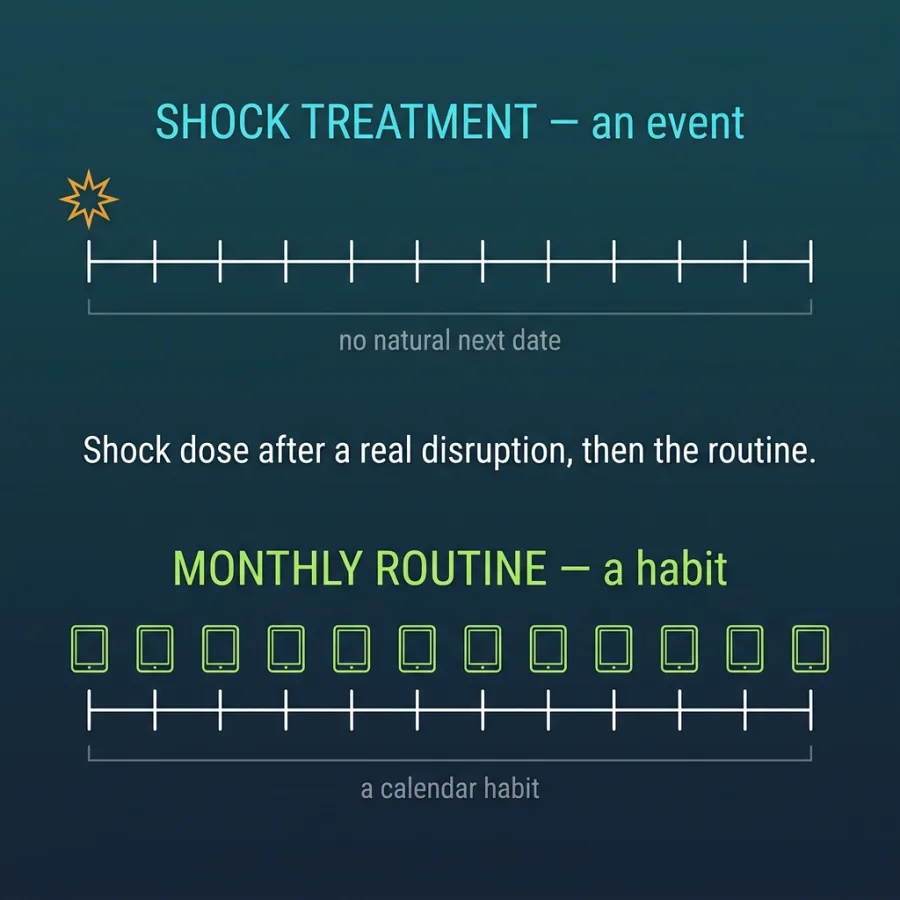
- Unclear repeat cadence. Shock framing gives you no obvious answer to “when do I do this again?”, which is precisely the question maintenance is supposed to settle.
Instant Power compared with Septifix
| Instant Power Septic Shock | Septifix | |
|---|---|---|
| Strategy | Sells an event | Sells a routine |
| Cadence | No natural next date | A tablet a month, a calendar habit |
| Dosing | Pour-and-flush liquid | Pre-measured tablet |
| Cost | Cheaper up front | Gap narrows over a year of dosing |
| Best used as | A shock dose after a biological disruption | Continuous monthly support |
- Strategy. Instant Power sells an event. Septifix sells a routine. If you want the tank supported continuously between pump-outs, a routine is what you are actually shopping for.
- Cadence. A tablet a month is a calendar habit. A shock bottle has no natural next date.
- Dosing. Pour-and-flush liquid versus a pre-measured tablet — both are low-friction, with the tablet slightly ahead on portion accuracy.
- Cost. Instant Power is cheaper up front. Compared over a year of consistent monthly dosing, the gap narrows considerably.
There is a legitimate combined approach: a shock dose after a genuine biological disruption, followed by a monthly routine. What does not work is treating the shock bottle as the routine.
Frequently asked questions
Will a shock treatment clear a septic odour in the house?
Usually not. Indoor septic odour most often traces to a dry P-trap, a blocked vent stack, or a failed toilet seal — none of which an additive addresses. Check those before buying anything.
Do I need a shock dose before starting monthly maintenance?
In most cases, no. A normally functioning tank does not need reseeding to begin a routine. It is a more defensible step after a genuine disruption such as heavy antibiotic use or a large bleach discharge.
Can it substitute for pumping?
No. Nothing in this category removes accumulated solids. Follow the pumping schedule for your tank size and household, typically every three to five years.
How often can I use a shock treatment?
Repeated shock dosing is a sign the underlying problem has not been identified. If you feel the need to shock the system regularly, book an inspection instead.
Is a liquid better than a tablet?
Not inherently. Liquid avoids measuring errors from powder; a pre-measured tablet avoids them entirely and stores more easily. Format matters mainly because it affects whether you keep the routine.
The bottom line
Instant Power Septic Shock is cheap, available, and honest about being a heavy dose. It is a reasonable purchase after a specific biological disruption, and a poor purchase as a response to a symptom you have not diagnosed.
If what you are really trying to buy is the confidence that your tank is being looked after month to month, a shock bottle is not that product. A pre-measured monthly supply is, and it comes with the one thing a shock dose structurally cannot provide: a next date.
Quick answer: Shock dosing answers a disruption. Monthly dosing answers maintenance. Work out which question you are asking, then keep pumping on schedule regardless of the answer.
Related comparisons
- Cabin Obsession vs Septifix
- RID-X vs Septifix
- Bio-Clean vs Septifix
- Best septic tank treatment: the full guide
- Septic additives vs pumping: what actually works
Essential septic guides
Affiliate disclosure: This guide contains affiliate links, including our Septifix partner link. If you purchase through one of these links, we may earn a commission at no additional cost to you. Our conclusions are based on product information and published guidance, not payment level.