Drain Field Replacement Cost: What You’ll Actually Pay
Quick Answer: What does drain field replacement cost?
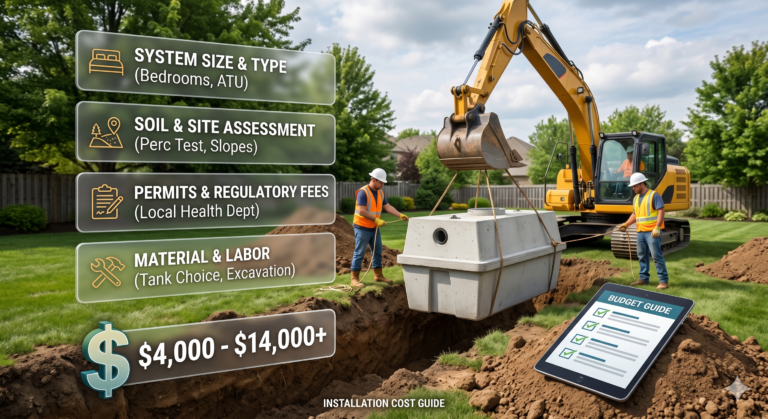
Most homeowners pay roughly $3,000 to $15,000 to replace a septic drain field, with a national average near $7,900. Repair or rejuvenation, where the field can still be saved, runs about $1,000 to $5,000. Those figures come from contractor-reported project data, not from any government price list — and the gap between the low and high end is mostly soil, access and system type.
- System type is the biggest swing: a conventional gravity field is the cheapest; a sand mound is several times more.
- Labour dominates. It is typically more than 60% of the bill, which is why access to your yard matters so much.
- The soil test and permit are separate line items, and you often pay them before anyone quotes the job.
- Rejuvenation is worth pricing first — but it only works on a field that has not fully failed.
- Grants rarely cover drain fields. Most funding is aimed at tanks and treatment units. There are exceptions, and they are worth finding.
First, an honest word about the numbers on this page
There is no official national price for replacing a septic drain field. No federal agency publishes one, no state publishes one, and the trade bodies do not either. Every cost figure you will find online — including on this page — traces back to one of two things: contractors reporting what they charged, or homeowners reporting what they paid.
That is worth knowing before you read another cost guide, because most of them present these ranges with the confidence of a published tariff. They are not that. They are a useful starting point for sanity-checking a quote, and nothing more.
The figures in the next two sections come from HomeGuide’s drain field cost guide, which states its basis openly: project costs reported by its members, last updated December 2025. We are citing it as what it is — an aggregator of reported jobs — not as an authority. Later in this guide we set out the numbers that are officially published, because a few of them are, and almost nobody quotes them.
What a drain field replacement actually costs
| Job | Reported range |
|---|---|
| Full drain field replacement | $3,000 – $15,000 |
| National average, all jobs | $7,900 |
| Lowest reported | $1,000 |
| Highest reported | $25,000 |
| Drain field repair or rejuvenation | $1,000 – $5,000 |
| Septic tank and drain field together | $4,500 – $20,000 |
| Moving the field to a new location | $5,500 – $21,500 |
The spread from $1,000 to $25,000 is not noise. It is the difference between re-laying a short run of pipe in sandy soil with a clear driveway, and building an engineered sand mound on a sloped lot where the machinery has to come in the long way round.
Cost by drain field type
This is the single largest factor, and it is not a choice you get to make freely. Your soil and your local health department decide which type you are allowed to install.
| Drain field type | Reported cost | When you end up with one |
|---|---|---|
| Anaerobic (conventional) | $2,000 – $6,000 | Standard gravity trenches. Requires soil that percolates well and enough depth to groundwater. |
| Aerobic | $7,000 – $10,000 | Where the soil cannot handle untreated effluent, so the wastewater is oxygenated before it reaches the field. |
| Evapotranspiration | $8,000 – $15,000 | Arid regions only. Wastewater evaporates through sand rather than soaking into soil. |
| Mound | $10,000 – $20,000 | High water table, shallow bedrock or poor soil. The field is built up above ground in imported sand. |
One thing worth noticing about that table: the by-type figures do not sit neatly inside the $3,000–$15,000 headline range quoted above — conventional fields fall below it and mound systems run past it. That is normal for aggregated cost data, where a headline range and a breakdown are compiled from different sets of reported jobs. It is also a good reason to treat any single national number as a rough bracket rather than a price.
If a contractor tells you that you need a mound system, that is usually not an upsell. It is what the soil report and the county permit will allow. The perc test result is what determines it, which is why that test comes first.
Where the money actually goes

Labour is typically more than 60% of the cost of installing a new field. That single fact explains most of what looks arbitrary about septic quotes: two identical fields on two identical soils can differ by thousands because one yard takes an excavator twenty minutes to reach and the other takes a day of careful work around a septic tank, a well, mature trees and a paved drive.
The line items that make up the rest:
| Line item | Reported cost |
|---|---|
| Percolation test | $600 – $2,000 |
| Permits | $250 – $650 |
| Replacing leach lines | $20 – $45 per linear foot |
| Septic tank pumping (required before a new field) | $300 – $700 |
| Septic inspection | $150 – $450 |
| Tree removal, if one is in the way | $400 – $1,200 |
| Sod to cover the finished field | $1 – $2 per square foot |
| Permit to abandon the old field | $100 – $250 |
Two of these catch people out. The perc test is usually paid up front and separately, before you have a quote for the actual work, and it can cost as much as a small repair. And the old field normally has to be formally abandoned — either capped with hydrated lime and covered, or dug out and the pipe taken to a licensed landfill — which is its own permit and its own cost.
Can you avoid a full replacement?
Sometimes. It depends entirely on why the field stopped working, and there are three realistic outcomes.

Rejuvenation — $1,000 to $5,000
Compressed air is injected into the soil through a hollow probe, fracturing it and letting oxygen back in so aerobic bacteria can recolonise. Hydro-jetting the lines to clear blockages runs $200 to $1,400. Both are worth pricing, and both only work on a field that is struggling rather than dead.
Partial repair — from $1,000
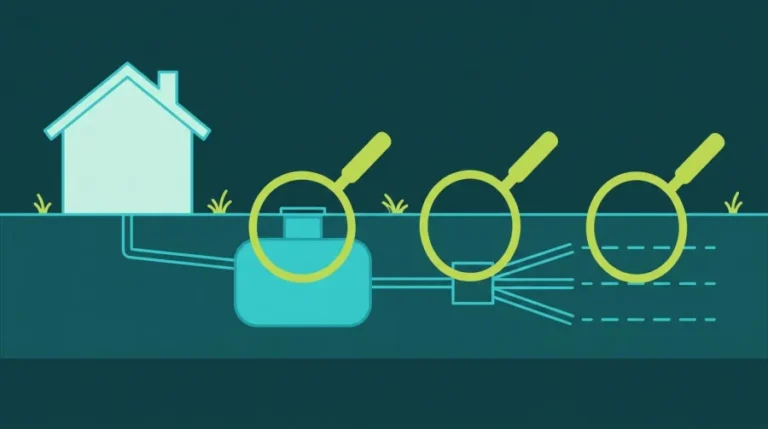
If one lateral has collapsed, or roots have got into a single run, replacing that section at $20 to $45 per linear foot is far cheaper than rebuilding the whole field. A camera inspection is what tells you whether the damage is local.
Full replacement — $3,000 to $15,000
When the biomat — the dense clogging layer that forms at the trench bottom — has sealed the soil across the whole field, there is nothing left to rescue. The soil itself has stopped accepting water. No additive, no jetting and no aeration reverses that, and anyone who tells you otherwise is selling something. This is also why additives are not a substitute for pumping: keeping solids out of the field is what delays this day.
A failed field is also the finding that cannot be quietly repaired at closing. In Massachusetts, for instance, soil absorption systems and cesspools are explicitly excluded from the conditional pass that lets a cracked tank or an uneven distribution box be fixed and still pass. If a sale is in the picture, see selling a home with a septic system.
The honest test is simple. If effluent is surfacing across the whole field and the ground stays soggy in dry weather, you are almost certainly replacing. If the problem is intermittent, or confined to one area, get a camera and a second opinion before you accept a five-figure quote.
The numbers that are officially published
Almost every cost guide stops at aggregator ranges. But a handful of real, government-published figures exist around this job, and they are useful precisely because you can check them.
County fees are published exactly. In Anne Arundel County, Maryland, the health department states its percolation test application fee at $450 and the installation permit for a nitrogen-reducing unit at $625. Your county will publish its own equivalents. These are the one part of the job you can price to the dollar before you speak to a contractor.
What a county programme actually pays. Hamilton County Public Health in Ohio publishes its live list of funded septic replacement projects with the grant percentage awarded to each — 100%, 85% or 50% by household income. It also states two things worth knowing: its whole-county allocation was $150,000, and it funds replacement and sewer connection but explicitly not repairs, because funding is limited. Three contractor bids are required.
And the exclusion nobody mentions. Maryland’s Bay Restoration Fund pays up to 100% of the cost of a nitrogen-reducing treatment unit for households earning under $300,000. According to Anne Arundel County, that grant does not pay for the drain field — the owner remains responsible for any septic work beyond the unit itself. Maryland runs a separate low and moderate income programme that does cover drain field costs.
That pattern repeats nationally. Most septic funding is built around tanks and treatment technology, because the policy goal is usually water quality rather than household hardship. Drain fields are frequently the excluded line. If you are applying for help, ask that question first.
How to get a real number for your property
A national average cannot price your yard. This sequence can, and it costs very little until the last step.
- Confirm the field has actually failed. Standing water, sewage odour over the field, backups and unusually green grass over the trenches all point to it — but so do cheaper problems. Our guide to the signs your septic system is failing covers how to tell them apart, and backups after heavy rain in particular are often saturation rather than failure.
- Call your county health department before any contractor. They hold your system’s permit and its as-built record, they publish their own fee schedule, and they will tell you which system types your soil permits. This call costs nothing and reframes every quote you receive afterwards.
- Get the perc test done. Until the soil is tested, nobody can tell you whether you are in the $3,000 conversation or the $15,000 one. It is the fork in the road.
- Take three written bids. Many funding programmes require three anyway. Ask each to price rejuvenation and partial repair alongside full replacement, and to state what is excluded — abandonment of the old field, landscaping, and the permit are the usual omissions.
- Ask about funding before you sign. Several programmes will not reimburse work that has already started.
How people actually pay for it
A five-figure repair on a system most people never think about is, for many households, not something savings can absorb. There is more help available than homeowners realise, and it is almost never found by searching for it nationally — it sits with your county.
USDA’s Section 504 programme lends up to $40,000 at 1% fixed over 20 years to rural owner-occupants, with grants up to $10,000 for owners aged 62 and over. County programmes funded through state revolving funds cover 50% to 100% of a replacement for qualifying households. Our full guide to septic system financial assistance sets out who qualifies, what the programmes exclude, and how to find the one your county runs.
How long it takes, and what to expect
Replacing a drain field takes 3 to 7 days of work, with about two more days if a new perc test is needed, and the final inspection typically follows one to two weeks after installation. A finished field is normally a set of trenches 18 to 36 inches deep and 1 to 3 feet wide, running 50 to 100 feet.
Expect your yard to be unrecognisable for a while. Expect to keep vehicles off the new field permanently. And expect the system to want the same maintenance the old one did — a new field fails the same way the old one did if solids keep reaching it, which is what regular pumping exists to prevent.
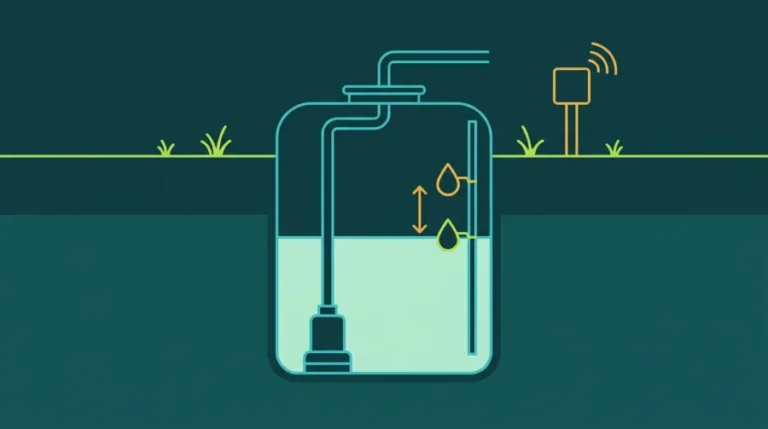
One early warning worth knowing: on a system with a pump chamber, a field that can no longer accept effluent shows up as a high-water alarm, because the pump runs with nowhere to send the water. It is the least common cause of an alarm, but the most expensive one — see what a septic alarm means.
FAQ: Drain field replacement cost
How long should a drain field last?
About 20 to 25 years when it is properly built and maintained, with pumping every 3 to 5 years. Fields fail early mainly from excess water, solids carryover from an unpumped tank, root intrusion and soil compaction from vehicles.
Is a mound system really that much more expensive?
Yes. Reported costs run $10,000 to $20,000 against $2,000 to $6,000 for a conventional field, because you are importing and building a sand structure rather than digging trenches. It is prescribed by soil conditions, not chosen.
Can I replace a drain field myself?
No, realistically. It requires permits, heavy excavation equipment and a crew, and many counties require a fresh perc test and an inspection before the trenches are covered. An improperly built field fails quickly and can contaminate groundwater.
Will a septic additive save a failing drain field?
No. Once the biomat has sealed the soil, no product reverses it. Additives support the bacteria in the tank; they do not restore a clogged soil interface. Air injection and jetting are the only mechanical interventions with a real chance, and only before full failure.
Does homeowners insurance cover it?
Usually not. Standard policies tend to exclude gradual wear, and drain field failure is nearly always gradual. Sudden accidental damage may be a different matter — read your policy rather than assume either way.
Should I replace the tank at the same time?
If the tank is near the end of its life, doing both together costs $4,500 to $20,000 and saves a second mobilisation and a second permit round. If the tank is sound, there is no reason to.
Essential septic guides
About these figures: cost ranges on this page are reported project costs published by HomeGuide, linked above, and are national estimates rather than an official price list. County fees and programme terms are quoted from the administering agency’s own published page and linked so you can check the current figure. Prices vary widely by region, soil and access — treat every range here as a way to sanity-check a local quote, not to replace one. This page contains no affiliate links.