Septic Tank Smell in the House: Causes & Fixes
Quick Answer: Why does my house smell like a septic tank?
A septic or sewer smell inside your home almost always means sewage gas is escaping somewhere it shouldn’t — usually through a dried-out drain trap, a bad toilet wax ring, a loose septic tank lid seal, or a vent pipe problem. Here’s the short version:
- Rotten-egg smell = hydrogen sulfide from sewage gas finding a leak point.
- Most common indoor cause = a dry P-trap in a seldom-used drain. Run water in every fixture first.
- Next check = toilet base (failed wax ring seal), floor drains, and your septic system vent pipe.
- Outside the house = a full tank needing a septic tank pump-out, or early drain field failure.
- Call a professional if the smell is constant, comes with slow drains, or you smell it near the tank or drainfield.
Below, a licensed septic professional’s walkthrough of every likely source, in the order you should check them, plus honest guidance on what’s DIY and what isn’t.
The form you have selected does not exist.
Quick answer: Indoor septic odor most often traces to a dry trap, a blocked vent, or a failed wax seal — check those first, because no additive fixes them. Where the smell traces back to a sluggish, overloaded tank, a monthly tablet is the routine-maintenance option. Septifix is our featured option to compare first.
What causes a septic smell inside the house?
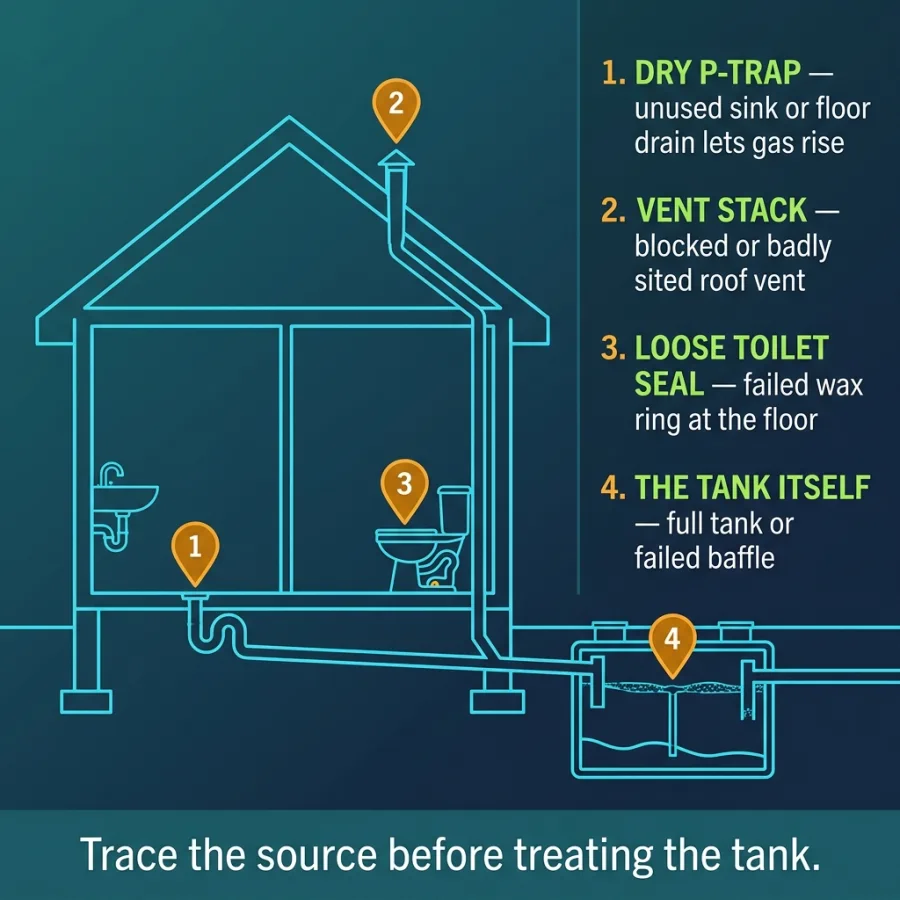
The odor you’re smelling is sewage gas — a mix of gases produced when anaerobic bacteria break down waste inside your septic tank. The two you’ll notice most are hydrogen sulfide (the rotten-egg smell) and methane (odorless on its own, but it rides along with the smelly stuff). This gas is supposed to travel up and out through your septic system vent pipe, well above the roofline. When you smell it indoors, gas is taking a shortcut through a leak in your plumbing or your tank.
Think of it as a plumbing system that’s designed to be airtight against gas but open to water. Every drain has a water seal. Every joint is sealed. When one of those seals fails — even a little — gas follows the path of least resistance into your living space.
Is septic gas dangerous?
In the concentrations you’d typically get from a dry trap or minor leak, the main problem is the smell and the nuisance. But sewage gas should never be ignored. Hydrogen sulfide is toxic at higher concentrations, and methane is flammable. A persistent, strong odor — especially in a basement, crawlspace, or enclosed area — deserves prompt attention and good ventilation. If anyone feels dizzy, nauseated, or short of breath, get outside and get fresh air first, then troubleshoot.
How do I find where the septic smell is coming from?
Work from the cheapest, most common cause to the most serious. Here’s the order I use in the field.
1. Check for dry P-traps (the #1 indoor cause)
Every drain has a P-trap — that U-shaped bend that holds a small pool of water. That water is a plug that blocks sewage gas from rising up the drain. If a fixture goes unused for weeks, the water evaporates and the gas pours right in.
- Guest bathrooms, basement sinks, floor drains, and rarely-used showers are the usual suspects.
- Fix: run water down every drain for 20–30 seconds. For floor drains, pour in a quart or two of water.
- For drains you’ll rarely use, add a tablespoon of mineral oil or cooking oil on top of the water to slow evaporation.
2. Inspect the toilet and its wax ring seal
If the smell is strongest in a bathroom and hangs around the base of a toilet, suspect the wax ring seal — the gasket between the toilet and the floor flange. A failed or loose ring lets gas escape at the floor.
- Signs: odor at the toilet base, slight rocking when you sit, or water seeping onto the floor around the base.
- DIY-capable if you’re handy: shut off water, drain and pull the toilet, replace the ring, reset with new bolts.
- Also check that the toilet is snug to the floor and the tank lid and connections aren’t cracked.
3. Check the vent stack
Your septic system vent pipe (the plumbing vent stack running up through your roof) lets gas escape safely and lets air in so drains flow smoothly. If it’s blocked — by a bird’s nest, leaves, ice, or debris — gas can back up and get pushed through weak points indoors.
- Symptoms: gurgling drains, slow drainage across multiple fixtures, and smell that comes and goes.
- A blocked vent is often a roof job — treat it as a safety task and use proper fall protection, or call a plumber.
4. Look at cleanout caps and access points
A cracked or loose cleanout cap, an unsealed basement floor drain, or a gap where pipes enter the foundation can all leak gas. Walk your lowest level with your nose and check every visible fitting.
5. Check outside near the tank and drainfield
If the smell is worse outdoors — near the tank, the septic tank lid seal, or over the leach field — the problem has moved from your plumbing to the system itself. That’s the next section.
Why does the area around my septic tank or drainfield smell?
Some faint odor near a vent or on a still, humid day can be normal. A strong, persistent smell over the tank or drainfield is not — it usually points to one of these:
The tank is full and needs pumping
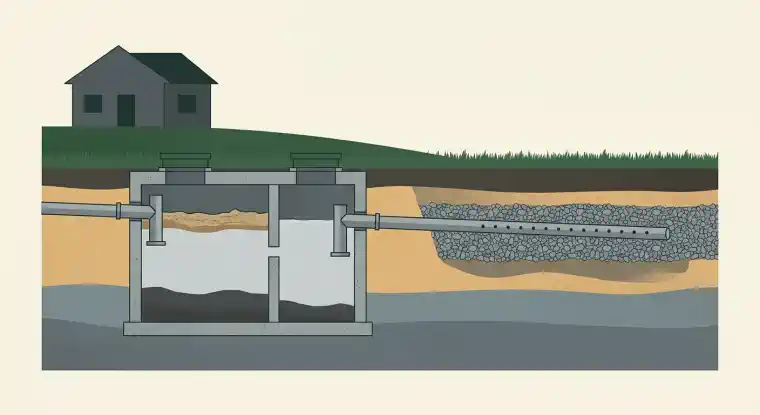
Inside the tank, solids separate into a floating scum layer on top and a settled sludge layer on the bottom, with liquid effluent in the middle. Over time those layers build up. When the tank gets too full, effluent carries solids toward the outlet, gas has less room, and odor increases. The fix is a routine septic tank pump-out by a licensed hauler.
A damaged lid seal or riser
The septic tank lid seal and any riser lids should sit flush and tight. Cracked concrete lids, warped plastic lids, or missing gaskets let sewage gas out at ground level. Reseating or replacing the lid and gasket usually solves it.
Baffle or distribution box problems
The inlet and outlet baffle keep the scum layer from washing out toward the drainfield. If a baffle is broken or corroded, solids can escape, effluent flow gets disrupted, and odors rise. Downstream, the distribution box splits effluent evenly across the drain lines — a clogged or tilted box sends too much flow to one area and can cause pooling and smell.
Early drain field failure
Under a healthy drainfield, a biomat — a thin biological layer — forms where effluent meets soil, and it does the final treatment before soil absorption takes over. But if the tank isn’t maintained and too many solids reach the field, the biomat thickens and clogs. Effluent then can’t soak in, so it surfaces. Warning signs of drain field failure include soggy or unusually green patches over the field, standing effluent, and a strong outdoor smell. This is one of the most expensive repairs in the whole system, which is exactly why routine care matters so much.
How do I fix a septic smell in the house? (Step-by-step)
- Run every drain and fixture. Refill all P-traps. Pour water into floor drains. Wait a day and reassess — this alone solves most indoor cases.
- Sniff-test the toilets. Check for movement, water at the base, and odor. Replace the wax ring seal if needed.
- Inspect visible pipes, cleanouts, and floor drains in the basement or crawlspace for cracks, loose caps, or gaps at the foundation. Seal what you find.
- Check the roof vent for blockages (from the ground with binoculars first). Clear it safely or call a plumber.
- Support the biology. If the tank hasn’t been treated in a while, add a quality bacterial maintenance product to help keep the scum and sludge layers digesting. This is maintenance, not a rescue for a full or failing tank.
- Check the tank’s pump-out history. If it’s been years, schedule a pump-out and inspection.
For step 5, I keep homeowners on a monthly bacterial dose to maintain a healthy population between pump-outs.
A monthly septic maintenance treatment adds bacteria and enzymes that help digest solids and reduce odor at the source.
For fixtures with sluggish drains that contribute to trap and vent issues, an enzyme-based drain maintainer is gentler on your system than caustic chemical cleaners.
If you want to actually see what’s happening inside the tank before deciding on a pump-out, a simple sludge-measuring tool tells you where your sludge layer stands.
Septic smell sources compared: cause, cost, and DIY vs. pro
| Source | Typical location of smell | Cost to address | DIY or Pro? |
|---|---|---|---|
| Dry P-trap | One unused fixture | Free | DIY |
| Failed wax ring seal | Base of a toilet | Low (parts) | DIY if handy / Pro |
| Blocked vent pipe | Whole house, comes and goes | Low–moderate | Plumber (roof safety) |
| Loose/cracked lid seal | Over the tank outdoors | Low–moderate | DIY or Pro |
| Full tank (needs pump-out) | Outdoors, near tank | Moderate | Licensed pumper |
| Broken baffle / distribution box | Tank area or over field | Moderate | Pro |
| Drain field failure | Soggy ground over drainfield | High | Licensed septic professional |
DIY fixes vs. calling a pro: how to decide
| Do it yourself | Call a professional |
|---|---|
| Refilling P-traps | Constant, whole-house odor with slow drains |
| Sealing cleanout caps / floor gaps | Standing water or wet ground over the drainfield |
| Wax ring replacement (if comfortable) | Any suspected baffle or distribution box damage |
| Routine bacterial maintenance | Tank overdue for a pump-out or inspection |
| Adding oil to rarely-used drains | Gas smell strong enough to cause symptoms |
When to call a professional
Some situations aren’t worth the risk or the guesswork. Call a licensed septic professional or licensed plumber if:
- The smell is constant and can’t be traced to a dry trap or single fixture.
- You have slow drains, gurgling, or backups in multiple fixtures at once — a sign of a system-wide issue, not a local one.
- There’s standing effluent, soggy soil, or bright-green grass over the drainfield.
- You suspect a damaged baffle, cracked tank, or distribution box problem — these require opening and inspecting the system safely.
- Your tank is overdue for a pump-out or you don’t know when it was last serviced.
- Anyone in the home experiences headaches, nausea, or dizziness — ventilate, leave the area, and get help.
A serious safety note: never enter a septic tank, and never lean into an open tank or riser. Sewage gas inside a confined space can incapacitate a person in seconds and be fatal. Tank access and inspection is confined-space work for trained, equipped pros only.
How do I prevent septic smells long-term?
- Pump the tank on schedule. Regular pump-outs keep the sludge layer from reaching the outlet and the baffle. A hauler can log your levels each visit.
- Feed the bacteria, don’t kill them. Limit harsh chemicals; keep a consistent bacterial maintenance routine.
- Watch what goes down. No grease, wipes (even “flushable”), feminine products, or excess food solids — they overload the scum layer and drains.
- Spread out water use. Overloading the system flushes solids toward the drainfield and stresses soil absorption.
- Run every drain periodically. Keep those P-traps full, especially in guest baths and basements.
- Protect the drainfield. Keep vehicles, heavy structures, and deep-rooted trees off it so the soil can breathe and absorb.
FAQ: Septic smell in the house
Why does my house smell like sewage only sometimes?
Intermittent odor usually points to a vent issue or a marginal trap. When wind, temperature, or heavy water use changes the pressure in your plumbing, gas gets pushed through a weak seal or a slightly blocked vent. Note when it happens — after a shower, on windy days, at night — and share that timing with a plumber; it narrows the diagnosis fast.
Can a full septic tank cause smells inside the house?
Indirectly, yes. A tank that’s overdue for a pump-out has less room for gas and can push odor back up the plumbing, especially if a trap or vent is already weak. But a full tank more often smells outdoors. If the smell is strictly indoors, check traps, the wax ring seal, and the vent before assuming it’s the tank.
Will septic treatment products get rid of the smell?
Bacterial maintenance products help by keeping the anaerobic bacteria active and the sludge layer digesting, which reduces odor at the source over time. They are prevention and upkeep — not a fix for a dry trap, a failed seal, a blocked vent, or a tank that needs pumping. Treat those causes directly, then use maintenance to keep things stable.
Is a rotten-egg smell always the septic system?
Not always. Hydrogen sulfide from sewage gas is the usual cause of a rotten-egg smell near drains and toilets. But the same smell can come from a hot water heater’s anode rod reacting with certain water, or from well water high in sulfur. If the smell is worst in hot water specifically, look at the water heater before the septic system.
When in doubt, start with the free fixes, then work outward. Most septic smells in the house are simpler and cheaper to solve than homeowners fear — and the ones that aren’t are exactly the ones a licensed septic professional should handle before they turn into a drainfield replacement. (For regulatory context, see the EPA guide to septic system types.)
Quick answer: Once the venting and seals are ruled out, keeping the tank on a routine is what stops odor returning. Check your tank size and the current package directions before ordering.
Essential septic guides
Affiliate disclosure: This guide contains affiliate links, including our Septifix partner link. If you purchase through one of these links, we may earn a commission at no additional cost to you. Our conclusions are based on product information and published guidance, not payment level.