Septic Tank Pumping Cost: What You’ll Actually Pay (and Why)
Quick Answer: What Does Septic Tank Pumping Cost?
Septic tank pumping cost depends mostly on your tank size in gallons, how easy the tank is to access, and local labor and disposal rates. Here’s the short version:
- Most homes have a 1,000–1,500 gallon tank, and that’s the typical pump-out a contractor handles in one visit.
- Bigger tanks, hard-to-find lids, and buried access points push the price up.
- Extra charges show up when the crew has to dig, add water, or deal with heavy solids accumulation.
- A routine pump-out interval of every 3–5 years is far cheaper than emergency service or a failed drainfield.
The single biggest cost driver isn’t the pumping itself — it’s neglect. A tank that hasn’t been serviced on a sensible maintenance schedule costs more to clean and risks repairs that dwarf any pumping fee.
What Are You Actually Paying For When a Tank Gets Pumped?
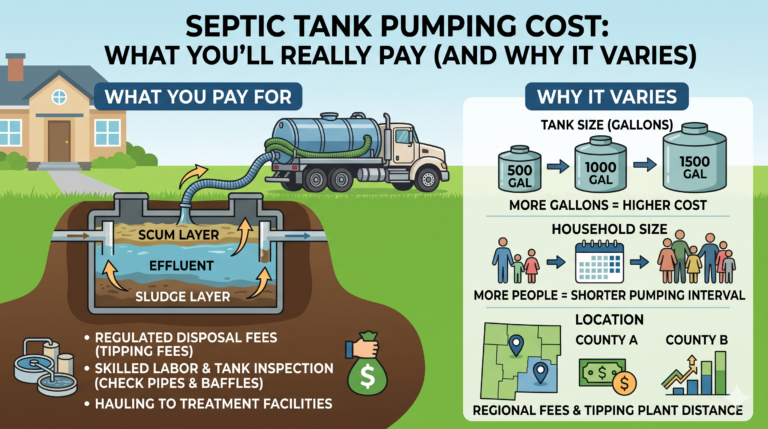
When a pumping truck rolls up, you’re not just paying someone to suck out a tank. You’re paying for the truck, the licensed operator, fuel, the time on site, and — this matters — the legal disposal of what comes out.
That waste can’t just be dumped. A licensed septic contractor hauls it to an approved treatment facility, and disposal fees vary a lot by region. In areas where the nearest facility is far away, that drive-time and tipping fee gets baked into your bill.
Here’s roughly how the work breaks down:
- Locating and uncovering access: If your lids are at grade and visible, this is quick. If they’re buried under a foot of soil or a garden, expect a digging charge.
- Pumping the tank: The crew removes both the floating scum layer and the settled sludge layer, not just the liquid effluent in between.
- Inspecting while empty: A good contractor checks the inlet and outlet baffle, looks at the tank walls, and notes anything off.
- Disposal: Legal hauling and dumping fees.
Why Does Tank Size Affect Septic Tank Pumping Cost So Much?
Bigger tank, more gallons, more material to haul and dispose of — it’s that simple. A 500-gallon tank is a fraction of the volume of a 2,000-gallon tank, and disposal is often priced by volume.
| Tank Size (Gallons) | Typical Household | Relative Pumping Cost |
|---|---|---|
| 500–750 | 1–2 people / small cabin | Lowest |
| 1,000 | 2–3 bedroom home | Standard |
| 1,250–1,500 | 3–4 bedroom home | Standard to moderate |
| 2,000+ | Large home or light commercial | Highest |
If you don’t know your tank size in gallons, your original septic permit or a septic system inspection report usually lists it. A contractor can also estimate it once the tank is open.
How Often Should You Pump — and How Does That Change the Cost Over Time?
The cheapest pumping strategy is consistent, scheduled service. A common rule of thumb is to pump every 3 to 5 years, but your real pumping frequency depends on:
- Household size: More people means more wastewater and faster solids accumulation.
- Tank size gallons: A small tank with a big family fills its sludge and scum layers faster.
- Water use habits: Garbage disposals, heavy laundry days, and water softeners all change the load.
- What goes down the drain: Grease, wipes, and chemicals slow the anaerobic bacteria that break down solids.
Stretching the pump-out interval too far is a false economy. When the sludge layer gets thick enough, solids escape into the outlet baffle and travel out toward the leach field. Once solids clog the soil in your drainfield, you’re no longer talking about a pumping bill — you’re talking about a partial or full system replacement.
What Hidden Charges Inflate the Final Bill?
The quoted price often assumes an ideal job. Here’s what can add to it:
- Digging to find the lid: Buried or paved-over access adds labor.
- Distance and disposal: Long hauls to the treatment facility cost more.
- Riser installation: A one-time charge that pays for itself by making future pump-outs cheaper.
- Heavy or compacted sludge: A badly neglected tank may need extra water and time, sometimes a return trip.
- Adding a filter or repairing a baffle: Small parts found during inspection.
- Pumping the second compartment or a separate distribution box: Some systems have more than one chamber to service.
If your distribution box is full of solids or your effluent filter is clogged, that’s a sign your tank is overdue. Cleaning these while the crew is already on site is cheaper than a separate trip.
Can You Reduce Pumping Cost Without Hurting the System?
Yes — but only in ways that protect the biology and the soil, never by skipping service.
- Install risers so lids are at grade. No digging means a lower labor charge every single visit.
- Protect the anaerobic bacteria. These microbes digest solids and slow how fast your sludge layer grows. Harsh cleaners and antibacterial overload can knock them back.
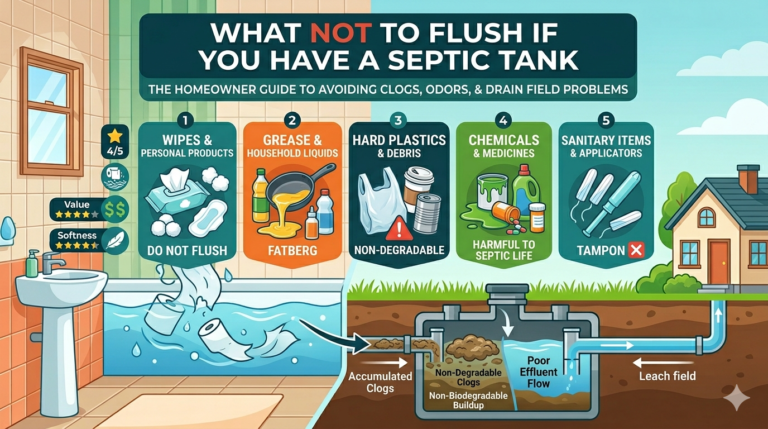
- Keep grease, wipes, and “flushable” products out. They don’t break down and they speed up scum buildup.
- Spread out water use so you’re not flushing solids through the tank during heavy-flow events.
For households that want to keep their bacterial balance healthy between pump-outs, a monthly maintenance treatment is an easy habit. I keep a steady-dose product on hand for clients with garbage disposals or higher loads.
This is a routine, no-drama maintenance product — not a substitute for pumping.
If you’ve got buried lids and you’re tired of paying to dig every few years, a riser kit is the single best return on investment for cutting future pumping cost.
And to actually track your sludge and scum layers between professional visits, a simple sludge judge tool lets you spot-check the tank yourself.
For a deeper walkthrough of keeping your whole system healthy, see our complete guide to septic system treatment and maintenance.
What Do Regulations Have to Do With the Price?
Septic systems are governed by a mix of federal guidance and local rules. Broadly, EPA regulations set the framework for protecting groundwater, but the specifics you’ll deal with are usually local. Many counties have state permit requirements that dictate who can pump, where waste can be disposed, and sometimes how often inspection or pumping must happen.
Those rules affect cost in real ways: licensed disposal isn’t free, and a permitted, insured contractor charges more than an unlicensed operator — for good reason. The licensed crew is the one who legally hauls your waste and won’t leave you holding the bag if something goes wrong.
Some areas also require a septic system inspection at the time of a property sale, and that inspection often includes checking soil percolation conditions around the drainfield to confirm the system is functioning.
When Should You Call a Professional?
Pumping itself is always a professional job — you should never open and enter a septic tank yourself. The gases inside are toxic and can be fatal, and the work requires the right equipment and disposal access.
Call a licensed septic contractor right away if you notice:
- Slow drains throughout the house at the same time.
- Sewage odors indoors or over the tank and leach field.
- Soggy, unusually green grass over the drainfield.
- Gurgling toilets or backups, especially after heavy water use.
- It’s simply been more than 3–5 years and you don’t know your last pump-out date.
These can signal a full tank, a failing baffle, a clogged distribution box, or early drainfield trouble — all of which get more expensive the longer they wait.
Frequently Asked Questions
How much does it cost to pump a 1,000-gallon septic tank?
A standard 1,000-gallon tank with easy access is the baseline job most contractors quote. Your actual price depends on local labor, disposal fees, and whether the crew has to dig to reach the lid. Buried access and heavy sludge are the most common reasons a “standard” job costs more.
Does adding septic treatment reduce how often I need to pump?
Maintenance treatments support the anaerobic bacteria that break down solids, which can help keep your sludge layer in check. But no product eliminates the need to pump. Solids still accumulate over time and must be physically removed.
Is it cheaper to pump on a schedule or wait until there’s a problem?
Scheduled pumping is almost always cheaper. Emergency calls cost more, and a neglected tank can send solids into the drainfield. Repairing or replacing a failed leach field is dramatically more expensive than any routine pump-out.
How do I find out my tank size if I don’t know it?
Check your original septic permit or any past inspection report — both usually list the tank size in gallons. If you can’t find paperwork, a contractor can estimate it once the tank is open and measured.