Septic System Financial Assistance: Grants and Loans
Quick Answer: Is there financial help to repair or replace a septic system?
Yes, but almost none of it is a federal grant you apply for online. One national programme takes applications directly from homeowners — USDA Section 504, for rural owner-occupants on a low income. Everything else flows down: federal money goes to your state, the state passes it to your county health department, and the county decides who gets it.
- Apply directly: USDA Section 504 — loans up to $40,000 at 1% fixed over 20 years, grants up to $10,000 for owners aged 62 and over.
- Apply locally: state-funded county programmes, which vary enormously and are usually competitive.
- The single best phone call you can make is to your county health department, not a federal agency.
- Money follows priorities, not need alone — a failing system near open water usually outranks an ageing one that still works.
- Budget for the gaps: permit fees, drainfield work and design costs are often excluded.
Why septic funding feels impossible to find
If you have searched for “septic system grants” and come up empty, the problem is not that the money does not exist. It is that the money almost never sits where people look for it.
Federal dollars for household wastewater are real and substantial, but the federal government mostly does not hand them to homeowners. It hands them to states. States hand them to counties, cities and local health districts. By the time the money reaches a form that an individual can sign, it has a local name, a local phone number and a local set of rules that nobody outside that county has heard of.
That is why a national search returns almost nothing useful, and why one call to a county office often returns everything. This guide works from the top of that chain to the bottom, so you know which door to knock on and what to expect behind it.
The one programme you can apply to directly: USDA Section 504
The Single Family Housing Repair Loans & Grants programme, known as Section 504, is run by USDA Rural Development and accepts applications from individual homeowners through local RD offices year round.
It is not a septic programme as such. It is a home repair programme, and a failing septic system falls squarely inside what it is designed to fix, because USDA frames grant-funded work as removing health and safety hazards. Raw sewage surfacing in a yard is the textbook example.
Who qualifies
USDA lists four conditions. You must own and occupy the house, be unable to obtain affordable credit elsewhere, and have a household income within the low or very-low limit for your county. For a grant specifically, you must also be age 62 or older and within the very-low limit.
The property must also be in an eligible rural area. USDA runs an eligibility site where you can enter a specific address rather than guess from a map — and “rural” there is broader than most people assume, covering many small towns and outer suburbs.
How much you can get
Straight from USDA’s own programme page:
- Maximum loan: $40,000, fixed at 1% interest, termed for 20 years.
- Maximum grant: $10,000, which is a lifetime limit.
- Loans and grants can be combined for up to $50,000.
A 1% fixed rate over 20 years is unusually generous, and it is worth noting that the loan half has no age requirement. A homeowner of 40 who does not qualify for the grant may still qualify for very cheap credit.
Two conditions people miss
A grant must be repaid if you sell the property within three years. If you are fixing a septic system in order to sell the house, that clause matters a great deal.
Separately, full title service is required once your total outstanding Section 504 balance exceeds $25,000, which adds cost and time to larger projects.
USDA also notes that approval times depend on funding availability in your area. The application window is always open; the money is not always waiting.
What your state runs, and why it exists
Below the federal layer sits the part of the system that actually pays for most septic replacements in the United States, and it is the part almost no national article describes properly, because it is different in every state.
EPA’s own page on programmes related to septic systems names the main channels: the Clean Water State Revolving Fund and the Section 319 Nonpoint Source Grant Programme. The Clean Water State Revolving Fund covers decentralised wastewater work, including repairing and replacing existing household systems, and it does not take applications from individual homeowners: the money goes to the state, and the state decides how to spend it. Section 319 is the other main channel states draw on for this work.
Two real examples show how differently that can turn out.
Ohio: state money handed to your county health district
Ohio EPA’s Water Pollution Control Loan Fund passes money to local health districts, which then run their own homeowner programmes. Hamilton County Public Health publishes its terms in full, and they are worth reading closely because they are typical of how these schemes behave.
Hamilton County was awarded $150,000 for the programme. Qualifying homeowners fall into one of three income-based tiers:
- 100% of the installation cost covered, at no cost to the owner.
- 85% covered, with the owner paying 15%.
- 50% covered, with the owner paying half.
Two details deserve emphasis. First, Hamilton County funds replacement or sewer connection, not repair — explicitly because funding is limited. Second, and more importantly: approval of an application does not guarantee funding. Projects are scored, ranked and funded from the top down until the money runs out.
That is the honest shape of most of these programmes. A whole county’s annual allocation may be less than the cost of a dozen system replacements. Qualifying is the beginning, not the end.
Maryland: money that follows nitrogen rather than hardship
Maryland’s Bay Restoration Fund works on a completely different logic, and it explains why some households with comfortable incomes receive full funding while some struggling ones do not.
The fund exists to reduce nitrogen reaching the Chesapeake Bay. It pays to replace conventional septic tanks with nitrogen-reducing units, or to connect to public sewer where it is available. Because the goal is water quality rather than affordability, the income thresholds are extraordinarily wide. According to Anne Arundel County Health Department, which administers the fund locally:
- Households with combined incomes up to $300,000 a year, and nonprofits, are eligible for 100% of the state-set Maximum Allowable Cost for the unit.
- Households above $300,000 and large businesses are eligible for grants reduced by 50%.
- Qualifying small businesses may receive 75% funding.
Priority runs by environmental risk, not by hardship: failing systems inside the Chesapeake Bay Critical Area — land within 1,000 feet of the high water line of tidal waters — come first, and permitted conventional systems outside the Critical Area come last.
The lesson generalises. If you live near a lake, bay, river or shellfish ground, there may be money available to you that has nothing to do with your income, because someone downstream has a nitrogen problem.
How these programmes actually run
Local programmes are administered, not automated. Hamilton County’s published timeline gives a realistic picture: the health district applies for its own allocation in August, learns in February or March whether it has money, holds a project review committee meeting in April or May, and installs approved projects between May and December.
Applications are accepted at any time, but they queue for that annual cycle. If an application sits more than six months before the review meeting, the applicant is asked to update their income figures.
The sequence between applying and digging typically looks like this.
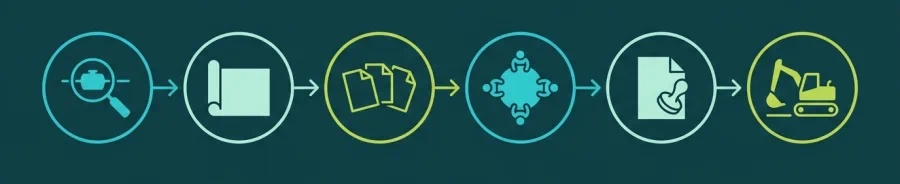
Note what sits in the middle of that chain: a system design and at least three bids from registered installers. Both are usually the homeowner’s responsibility to arrange before a decision is made, and both take weeks. Starting early matters more than almost anything else.
What the money covers, and what it does not
The most common disappointment in these programmes is not rejection. It is discovering that the grant covers a narrower slice of the job than expected.
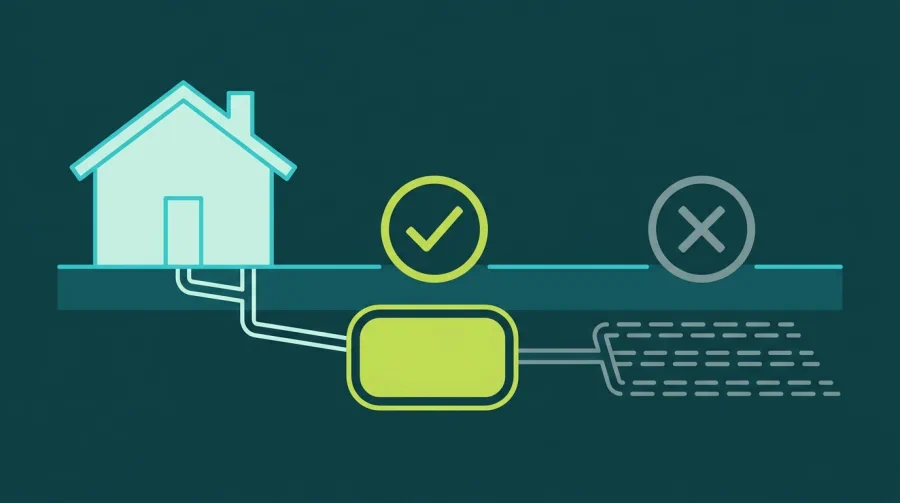
Maryland’s fund illustrates the gap precisely. The grant covers the nitrogen-reducing unit up to a maximum allowable cost. In Anne Arundel County, the property owner remains responsible for the county percolation test application fee of $450, the installation permit fee of $625, and any other septic work beyond the unit itself — drainfields included. And if no contractor is willing to install for the maximum grant amount, the homeowner pays the difference.
Maryland runs separate assistance for low and moderate income households covering drainfield, dry well and other repair costs, which is exactly the sort of secondary programme you only find by asking. When you call your county, ask specifically what is excluded, and whether a second programme covers the exclusions.
Owners of advanced treatment units should also budget for the obligation that follows: Maryland requires the system to be maintained through a certified service provider and inspected at least once a year, for the life of the system.
How to find the programme in your own county
This is the part that actually works, and it takes about an afternoon.
- Call your county or district health department first. They permit septic systems, so they know every funding source that touches one locally — including small programmes that are never advertised online. Ask directly: “Do you administer any financial assistance for replacing a failing sewage treatment system?”
- Ask about your watershed. If you are near any protected water body, ask whether a water-quality programme covers your address. This is the question most homeowners never think to ask, and it is where the largest grants are.
- Check USDA Section 504 in parallel. Contact your local Rural Development office and confirm your address on the USDA Eligibility Site. It is a separate track and does not conflict with a county programme.
- Ask your state’s environmental agency how it distributes Clean Water State Revolving Fund and Section 319 money for decentralised systems, and which local entities received it this year.
- Get a written diagnosis before you apply. Nearly every programme prioritises documented failure. An inspection report showing a failing system moves you up the list; a suspicion does not.
Free help with the paperwork
Two national nonprofits named on EPA’s septic programmes page provide technical assistance to small communities and households, including help navigating funding. Neither hands out money, but both can tell you what exists in your area.
- The Rural Community Assistance Partnership (RCAP), which works through six regional partners across the United States.
- The National Rural Water Association’s wastewater programme, which places technicians in most states.
EPA also maintains a Water Finance Clearinghouse for water funding information.
What to do while you wait
Funding cycles run in months, and a failing system does not pause for them. Two things are worth doing immediately.
Confirm what you are actually dealing with. Several problems that look like system failure are cheaper plumbing faults, and a correct diagnosis changes both the cost and the application. Our guide to the signs your septic system is failing covers how urgent each symptom is, and backups after heavy rain in particular are often a saturated drainfield rather than a dead tank.
Then protect what you still have. A tank that is overdue for pumping will fail faster, and pumping costs a fraction of replacement — see what septic pumping actually costs and how often you should pump. Reducing water use and keeping vehicles off the drainfield costs nothing at all.
If replacement really is coming, knowing the number helps you judge whether a 50% grant closes the gap. Our breakdown of septic tank installation cost sets out what a full system runs today.
FAQ: Septic system financial assistance
Are there federal grants specifically for septic systems?
Not as a direct-to-homeowner programme. Federal septic money flows to states through channels such as the Clean Water State Revolving Fund and Section 319 grants, and the states distribute it locally. The closest thing to a direct federal grant is USDA Section 504, which is a home repair grant that a septic failure can qualify for.
Can I get help if I am not low income?
Sometimes, yes. Water-quality programmes fund by environmental priority rather than hardship. Maryland’s Bay Restoration Fund covers 100% of the allowable unit cost for households earning up to $300,000 a year. Ask about your watershed before assuming your income disqualifies you.
Does assistance cover repairs, or only full replacement?
It varies by county, and you cannot assume. Hamilton County in Ohio funds replacement and sewer connection but explicitly does not fund repairs, citing limited funds. Other districts do fund repairs. This is a question for your local health department.
How long does it take to get funded?
Plan in seasons rather than weeks. Local programmes typically run an annual cycle with a single review meeting, and installation windows of several months. USDA notes that its own approval times depend on funding availability in your area.
Do I have to pay a septic grant back?
Usually not, but read the conditions. USDA Section 504 grants must be repaid if you sell the property within three years. County grants funded through revolving funds are often structured as forgivable, but terms differ by programme.
Will a grant cover my drainfield?
Often not. Programmes built around treatment technology tend to fund the treatment unit and exclude the drainfield, permits and design fees. Ask what is excluded and whether a separate programme covers those costs — in Maryland, one does.
If it is the drainfield you are funding, it helps to know the number before you apply, since several programmes exclude drainfield work. Our drain field replacement cost guide breaks the job down by system type and line item.
Essential septic guides
Please note: programme figures, income limits and fees change from year to year and differ by county. Every figure above is taken from the administering agency’s own published page at the time of writing, and each is linked so you can confirm the current terms before you apply. This page contains no affiliate links.