Septic Additives vs Pumping: What Works
Quick Answer
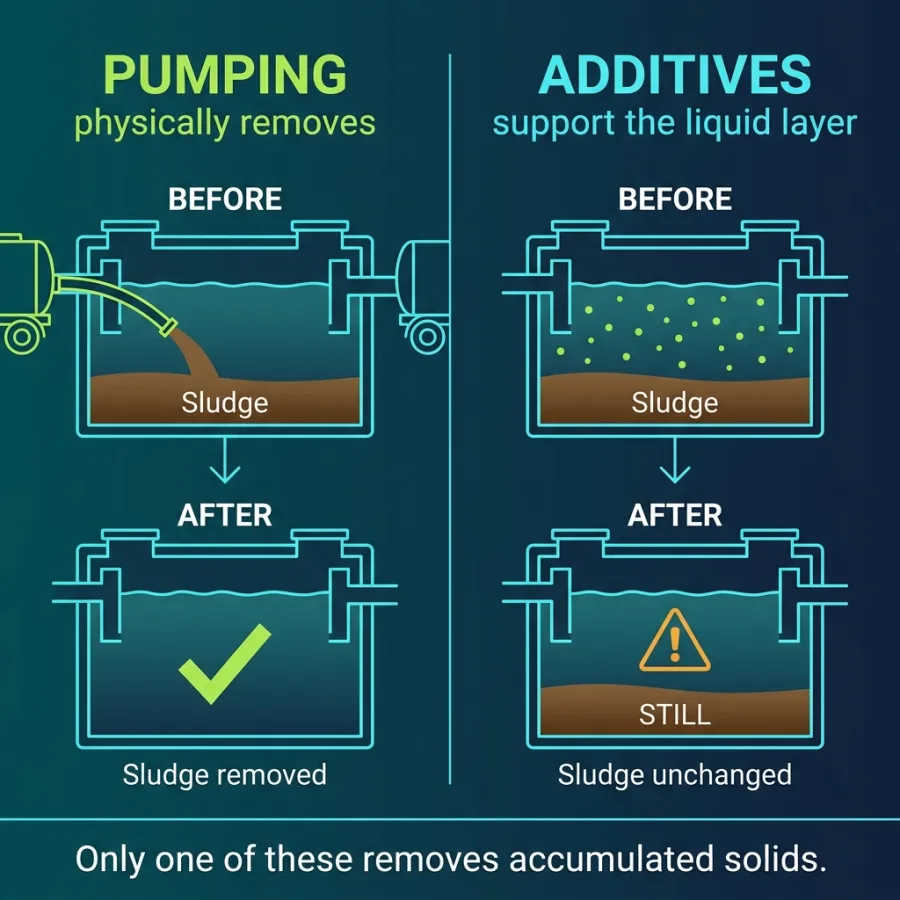
Regular pumping — not additives — is what actually prevents backups and drain field failure. Pumping physically removes the sludge and scum layers that build up in your tank; additives cannot do that. Here’s the short version:
- Pumping is essential. It’s the only way to remove accumulated solid waste before it reaches your leach field.
- Additives are optional at best. A healthy tank already grows the bacteria it needs.
- Some additives can hurt you. Certain chemical additives may damage your system or drain field.
- Follow your pump-out interval. Most households land in the 3-to-5 year range depending on tank size and use.
I’ve been servicing septic systems for over 15 years, and no question comes up more often than this one: “If I pour in a bottle of septic tank additives every month, can I skip pumping?” The honest answer is no. Below I’ll walk you through exactly what’s happening inside your tank, what additives can and can’t do, and how to spend your maintenance dollars where they actually protect your system.
The form you have selected does not exist.
What Does a Septic Tank Actually Do?
Your septic tank is a settling and separation chamber. Wastewater flows in and slows down, and gravity does the first job. Heavier solids sink to the bottom and form the sludge layer. Fats, oils, and lighter material float to the top and form the scum layer. The relatively clear liquid in the middle — called effluent — is what exits the tank and flows out to your drain field (also called the leach field).
Inside the tank, anaerobic bacteria — bacteria that live without oxygen — break down a portion of the organic solids. This is normal, healthy biology, and it happens on its own in virtually every functioning tank. The baffle at the inlet and outlet keeps the scum layer from rushing out to the drain field, and the outlet baffle protects the pipe leading to your distribution box, which spreads effluent evenly across the leach lines.
The key point: bacteria break down some solids, but not all of them. What’s left keeps accumulating. That leftover solid waste accumulation is exactly why pumping exists.
Why Doesn’t a Septic Tank Empty Itself?
Even with a thriving bacterial population, a meaningful fraction of what goes down your drains simply doesn’t break down — inorganic material, certain fibers, grease, and mineral solids. Over months and years, the sludge layer climbs from the bottom and the scum layer thickens from the top. Eventually there’s less and less room for water to settle properly.
When the tank gets too full of solids, two things happen:
- Solids get pushed out toward the outlet and into the drain field.
- Effluent leaves before it’s properly separated.
Both are bad. Solids reaching your leach field clog the soil pores and accelerate the biomat — the naturally forming biological layer along the trench walls. A little biomat is normal and even helps treat effluent; too much biomat, choked with excess solids, chokes off percolation and soil absorption. That’s the beginning of drain field failure, and a drain field is the single most expensive component to replace.
Field Note
By the time you smell odors in the yard or see water pooling over the leach lines, damage is usually already underway. The cheapest repair is the pump-out you scheduled on time. The most expensive repair is the drain field you replaced because you kept skipping it. (For regulatory context, see the EPA Septic Systems Overview.)
What Do Septic Tank Additives Claim to Do?
Septic tank additives come in a few broad categories, and they don’t all behave the same way. Understanding the differences matters, because some are harmless and some are genuinely risky.
- Biological additives — bacteria and enzymes intended to boost the natural breakdown of solids. This group includes enzyme additives and yeast additives.
- Chemical additives — solvents, acids, or bases marketed to “dissolve” clogs or degrease.
- Inorganic additives — mineral or acidic compounds.
The marketing pitch is almost always the same: pour this in and you can pump less often, or never. That claim is where practitioners and manufacturers part ways.
Do Biological and Enzyme Additives Work?
A healthy septic tank already contains a robust population of anaerobic bacteria — every flush reseeds it. In most systems, there is no bacterial shortage to fix. Biological additives (including enzyme and yeast additives) generally aren’t harmful, and in specific situations — after antibiotics, after a big bleach-heavy cleaning binge, or in a newly started system — a bacterial boost may help re-establish the population.
What they will not do is remove the sludge layer. Bacteria break down organic solids but leave behind inorganic material and residue. No enzyme dissolves the accumulated inert solids at the bottom of your tank. That’s a mechanical job for a pump truck.
Are Chemical and Inorganic Additives Dangerous?
This is where I get blunt with customers. Harsh chemical additives and some inorganic additives can do real damage:
- They can kill off the beneficial bacteria your tank depends on.
- Solvent-based products can pass through the tank and reach the drain field, harming soil and risking groundwater contamination.
- Some products emulsify grease, letting the scum layer flow out to the leach field where it clogs the biomat.
General guidance from public health and environmental sources — including EPA guidelines that encourage regular pumping and inspection — leans toward caution with chemical additives, and many local health departments discourage them. If a product promises to eliminate the need for pumping, treat that as a warning label, not a feature.
Septic Additives vs Pumping: Side-by-Side
| Factor | Pumping | Biological Additives | Chemical / Inorganic Additives |
|---|---|---|---|
| Removes sludge layer | Yes — physically | No | No |
| Removes scum layer | Yes | No | May wash it into drain field (bad) |
| Protects the drain field | Yes | Neutral | Can harm it |
| Supports bacteria | Indirect (resets load) | Possibly, in specific cases | Can kill bacteria |
| Groundwater risk | None (proper disposal) | Low | Possible |
| Can replace pumping? | N/A — it IS the maintenance | No | No |
| Pro verdict | Essential | Optional / situational | Avoid harsh ones |
How Often Should You Actually Pump?
Your pump-out interval depends on tank size, household size, and how much water and solids you send down the drain. A common range is every 3 to 5 years for a typical household, but that’s a starting point, not a guarantee. A small tank serving a large family may need pumping more often; a large tank serving one or two people may go longer.
The right way to set your pump-out frequency is measurement, not a bottle of additive:
- Have your pro measure the sludge and scum layers at inspection.
- Pump when solids occupy roughly a third of the tank’s working depth — your technician can tell you the exact reading.
- Keep records so you can predict your own interval over time.
For a fuller walkthrough of routine care, see our complete septic tank treatment and maintenance guide, which covers inspection intervals and what to watch for between pump-outs.
Pro Tip
Watch your water use, not just your tank. Doing eight loads of laundry in one day creates hydraulic overload — you push liquid through faster than the tank can settle it, and partially treated effluent races out to the drain field. Spread laundry across the week. It’s the cheapest drain field protection there is, and no additive substitutes for it.
What Are the Real Warning Signs of Trouble?
Learn these, because catching them early saves thousands:
- Slow drains throughout the house at once (not just one fixture).
- Gurgling in toilets or drains.
- Sewage odors indoors or over the tank/drain field.
- Wet, spongy, or unusually green grass over the leach field.
- Backups into the lowest drains in the house.
Any of these can signal solid waste accumulation reaching the outlet, a failing baffle, a plugged distribution box, or early system failure at the drain field. None of them are fixed by pouring in additives.
What Actually Keeps a Septic System Healthy?
Here’s the maintenance hierarchy I give every customer, in order of importance:
- Pump on schedule. Non-negotiable.
- Manage water use. Fix leaks, spread out laundry, add faucet aerators.
- Keep solids and grease out. No wipes, no grease down the drain, minimal garbage disposal use.
- Protect the drain field. No parking, driving, or heavy structures over it; divert roof and surface runoff away.
- Go easy on harsh chemicals. Excess bleach and drain cleaners knock back your bacteria.
If you want to support the bacterial side of things between pump-outs, a gentle monthly biological maintenance product is a reasonable, low-risk choice — just understand it’s a supplement to pumping, never a replacement.
Can a simple monthly tablet really protect an aging septic system? For homeowners looking to proactively control odors and manage waste, this routine is worth exploring.
Check: Septifix Septic Tank Treatment Tabs →
For routine bacterial maintenance, I point folks toward a straightforward, well-established biological treatment.
When a system has taken a chemical hit — say after heavy antibiotic use or an aggressive cleaning stretch — a concentrated live-bacteria and enzyme blend can help re-establish the population faster.
And for households that want a simple monthly dosing routine without harsh chemistry, a dissolvable packet-style treatment keeps things consistent.
When Should You Call a Professional?
Call a licensed septic professional if you notice any of the following:
- Backups, standing water over the drain field, or persistent sewage odors.
- You don’t know your tank’s location, size, or last pump date.
- It’s been more than 3–5 years since your last pump-out.
- You suspect a damaged baffle, cracked tank, or clogged distribution box.
- You’re buying a home and need a system inspection.
A pro can measure your sludge and scum layers, inspect the baffles and distribution box, and give you an evidence-based pump-out interval. Septic issues fall squarely into money-and-health territory — when in doubt, get eyes on the system rather than guessing. And never enter a septic tank yourself; the gases inside can be fatal within seconds.
FAQ
Can septic additives replace pumping?
No. Additives cannot remove the sludge layer or scum layer from your tank — only physical pumping does that. Additives are, at best, a supplement to a regular pump-out schedule.
Are enzyme or yeast additives safe for my septic system?
Biological additives, including enzyme and yeast additives, are generally low-risk and won’t harm your tank. They just won’t remove accumulated solids or extend your pump-out interval in a healthy system.
How often should a septic tank be pumped?
A common range is every 3 to 5 years for a typical household, but the real answer comes from measuring your sludge and scum layers. Tank size and household water use shift the interval significantly.
Which additives should I avoid?
Avoid harsh chemical and solvent-based additives. They can kill beneficial bacteria, push scum into your drain field, and create groundwater contamination risk. Skip any product that claims you’ll never have to pump again.
Bottom line: Additives are a debate; pumping is a requirement. Keep your anaerobic bacteria happy, protect your drain field from hydraulic overload and grease, and stay on your pump-out schedule. Do that, and backups and drain field failure become rare events instead of expensive surprises.
Compare the alternatives
If you are weighing brands before committing to a routine, these side-by-side comparisons cover the products homeowners ask about most:
- RID-X vs Septifix — the supermarket default, and where its powder format costs you consistency.
- Bio-Clean vs Septifix — a drain-and-tank crossover, and when the dual purpose is worth the extra effort.
- Instant Power Septic Shock vs Septifix — shock dosing versus monthly maintenance, and why they answer different questions.
- Cabin Obsession vs Septifix — built for seasonal and intermittently used properties.
This is also why no additive rescues a drainfield once the biomat has sealed the soil. At that point the decision is a repair-or-replace one — see our drain field replacement cost guide for what each option costs and how to work out which one applies.
Essential septic guides
Affiliate disclosure: This guide contains affiliate links, including our Septifix partner link. If you purchase through one of these links, we may earn a commission at no additional cost to you. Our conclusions are based on product information and published guidance, not payment level.